In the Moors and Christians fiestas, a comparsa is a troupe of festeros (fiesta members) who turn out under one name, in one costume and on one side, Moorish or Christian. If searching for “comparsa” brings up the Cádiz Carnival, that’s something else entirely: here we mean the group that keeps a town’s fiesta going all year round.
What a comparsa is in Moors and Christians
Each side is made up of several comparsas. Each one has its own name (Estudiantes, Contrabandistas, Zíngaros, Marroquíes, Abencerrajes…), its costume, its committee, its officers and a clubhouse where members meet, which depending on the town is called a cuartelillo, a kábila, a maset or a capitanía.
What you see in the street is three or four days of parades, but behind them are members paying their subscriptions, rehearsals, ceremonies to present the officers, get-together lunches and accounts to keep. In Alcoy, the 2019 decree reckoned each filà handled around 120,000 euros a year on average, all of it put in by its own members.
Comparsa and filà: same idea, different name
In Alcoy they don’t say comparsa but filà (plural filaes). According to the decree that made Alcoy’s fiesta part of Spain’s protected intangible heritage (Bien de Interés Cultural inmaterial) in 2019, the word appears around 1804 for new groups within the two sides, probably made up of friends who wore the same costume and started to stand out with a name of their own. Each filà is organised into squads (escuadras), and its president is the primer tro.
Today Alcoy has twenty-eight filaes, fourteen Moorish and fourteen Christian. Every year, four of them, two from each side, take their turn to provide the captain and the alférez, and according to the Universitat de València that turn is awaited “for many long years”.
How many comparsas there are in the Vinalopó and Alcoy
The number and the names vary hugely from town to town:
| Town | Comparsas | Split | Source (year) |
|---|---|---|---|
| Alcoy | 28 filaes | 14 Moorish, 14 Christian | Decree 51/2019 (2019) |
| Villena | 14 comparsas | 7 Moorish, 7 Christian | Turespaña |
| Elda | 9 comparsas | 4 Moorish, 5 Christian | Ministry of Industry and Tourism (2026) |
| Aspe | 8 comparsas | 4 Moorish, 4 Christian | Turismo de Aspe |
In Aspe, the eight make up the Unión de Moros y Cristianos Virgen de las Nieves: Cristianos Duque de Maqueda, Cristianos Estudiantes, Lanceros de Uchel and Cristianos Contrabandistas de la Sierra Negra on the Christian side; Moros Aljau, Moros Fauquíes, Moros Alcaná and Moros Sulaymán on the Moorish side. Aspe’s fiesta is a young one: the first was held in 1978.
In Elda, the Christian side is made up of Estudiantes, Cristianos, Contrabandistas, Piratas and Zíngaros, and the Moorish side of Marroquíes, Realistas, Musulmanes and Huestes del Cadí. Between them they had more than 7,000 festeros in 2026, some comparsas had over a thousand members, and more than half of all members were women, according to the Ministry.
What a comparsa does during the fiestas
- It parades in the Moorish and Christian entradas with its squads, its band and its officers.
- It provides the fiesta officers when its turn comes round: captain, alférez, standard-bearer, ambassador, depending on the town.
- It takes part in the events on the programme, such as the embajada and the alardo.
- It opens its clubhouse to members, family and guests between events.
The comparsa at mealtimes
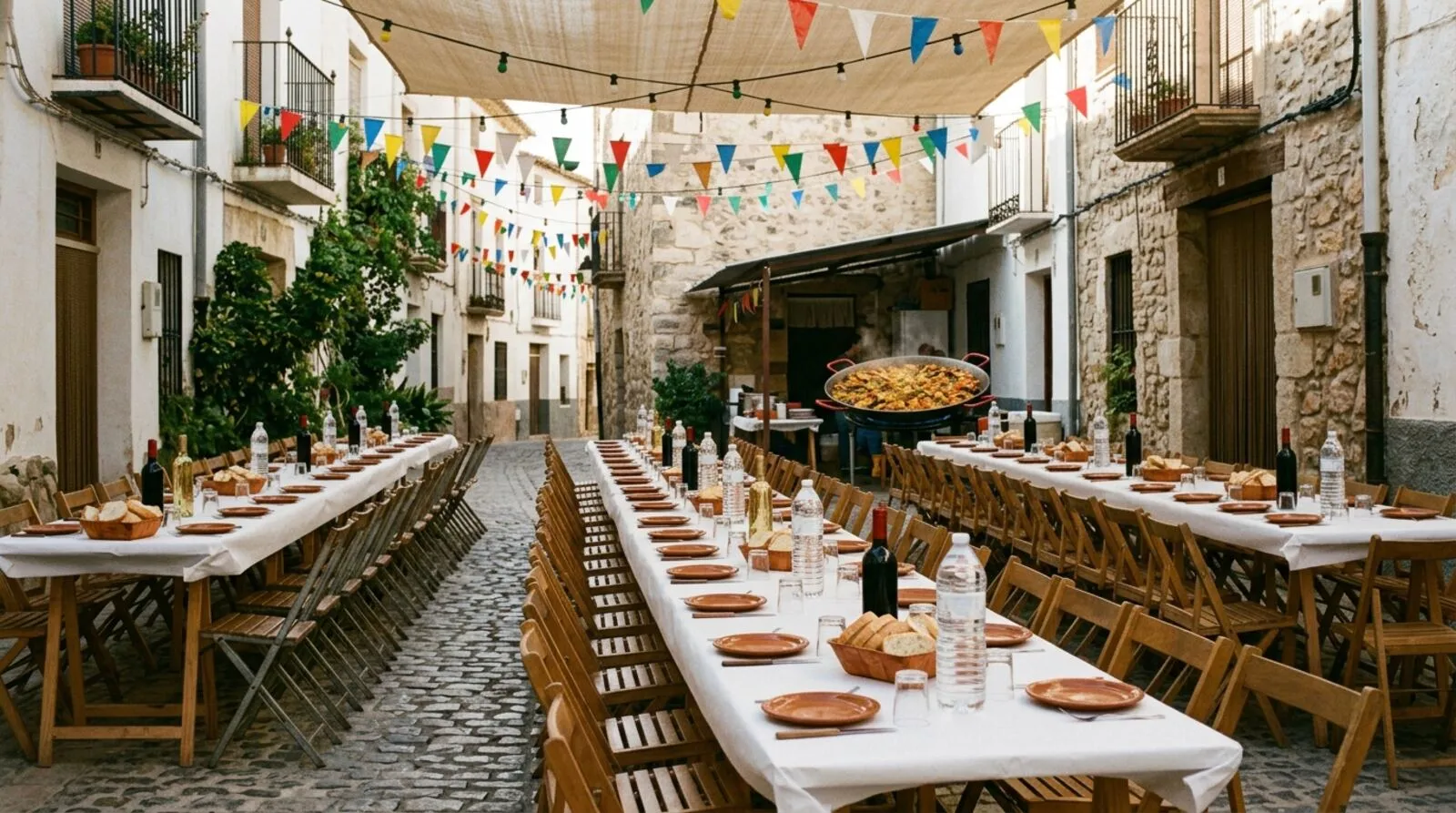
Food is part of the fiesta. In Alcoy, on the eve of the entradas, every filà holds the Nit de l’Olla, a dinner for festeros and musicians. In other towns, the get-together lunch or the dinner after the parade plays the same role: bringing the whole fiesta family together.
If you’re on the committee and it’s your job to organise it, our article on the comparsa or filà meal has a planning timeline and portion guide. And if you’d rather we did the cooking, here’s our catering for Moors and Christians comparsas: comparsa lunches, drinks receptions for presenting the officers and a bar in a marquee over several days.
For more vocabulary from the table and the fiesta, explore Charanga and Escuadra (Moors and Christians).
Sources
- BOE: Decreto 51/2019, fiesta de Moros y Cristianos de Alcoy, Bien de Interés Cultural inmaterial
- Spanish Ministry of Industry and Tourism: Elda’s Moors and Christians, Festival of International Tourist Interest
- Turismo de Aspe: Moros y Cristianos
- Spain.info: Fiesta de Moros y Cristianos de Villena
- Universitat de València: Alcoy’s Moors and Christians, the entradas
- DLE (RAE): comparsa