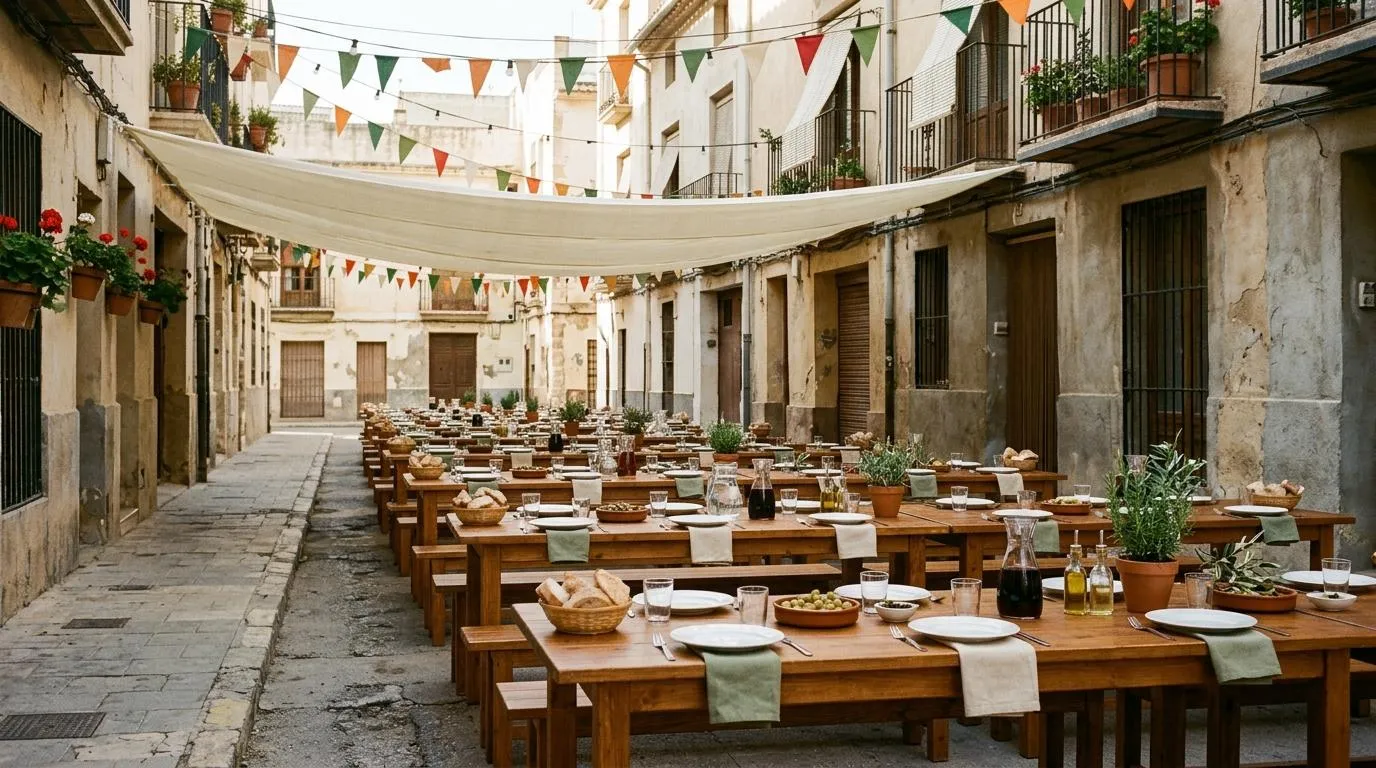
A Hogueras barraca (barraca de Hogueras) is the fenced-off enclosure that a barraca committee sets up in the street during Alicante’s Hogueras de San Juan, from 20 to 24 June, so that its members can have lunch, dinner and enjoy the fiesta together. Behind it there is a festive association with a life of its own and, at the door, a decorated entrance arch, the portada, that burns on the night of the cremà.
Barraca and racó: how they differ
In the street the two words get mixed up a lot, and even the Generalitat’s tourist glossary puts them together (“barraca o racó foguerer”, a meeting place for the members of a foguera and their guests). But in the way the fiesta is organised they are different things. The Consell decree that declared the Fogueres a Bien de Interés Cultural (protected intangible heritage) explains it like this:
| Barraca | Racó | |
|---|---|---|
| Who is behind it | A barraca committee, with its own board | The committee of a foguera |
| What it is | The fenced-off space that the barraquers set up in the street during the fiestas | The foguera’s clubhouse, “a place designed for its members to get together” |
| Relationship with the foguera | An independent association, but linked to a foguera by district | Part of the foguera itself |
| Its members | Barraquers | Foguerers |
| Hallmark | The portada at the entrance | The committee’s monument |
Alicante City Council also counts them separately. A municipal decree of September 2026, drawn up for the 2027 Hogueras, set a single racó per hoguera, froze the floor space of racós and barracas at its 2026 level, with a maximum of one thousand people, and authorised no new hogueras or barracas for that year.
Who the barraquers are
A barraca committee meets during the year at its clubhouse and, from 20 to 24 June, moves out into the street. The activity is paid for by the members through their contributions, which is why, as Antonio Galindo, president of the federation that groups them, explained to Alicante Plaza, each barraca is measured in tables or in members: “there are barracas with thirty tables, but with sixty members, because they have to share if they don’t have more space”. In 2025 about fifty took part. All the committees, hogueras and barracas alike, belong to the Federació de Fogueres de Sant Joan, the body that organises the fiesta.
The tradition goes back a long way: the first barraca was created in 1931 by the peña Els Trenta-u, only three years after the first official Hogueras.
The portada, its calling card
Since that first barraca, the portada is what sets each one apart. It is made by hogueras artists or by the committee itself, placed at the entrance to the enclosure, and carries reliefs or three-dimensional motifs about the fiesta, traditions, food, the city or current affairs. Like the monuments, it competes in categories according to its budget and a jury rewards the best. On the night of the 24th it burns along with the hogueras.
A day in the barraca
On the night of 20 June, as the adult monuments are set up, the racós and barracas go up. From then on the barraca is home base: the despertà (morning wake-up of firecrackers) at dawn, the two o’clock mascletà in Plaza de los Luceros, lunch, then dinner and a verbena (open-air dance) at night. On the 24th, at midnight, the palmera from Santa Bárbara castle gives the signal for the cremà and closes the cycle.
The barraca as a field kitchen
For anyone who cooks, a barraca is a pop-up restaurant in the middle of the street: a marquee, little space, lots of people and timetables dictated by the programme. At Xepep we prepare catering for Hogueras and barracas: lunches and dinners for the committee, kitchen and bar inside the marquee and a menu we plan with you. Bar orders are logged with QR ordering, so the committee always knows what has been served.
To see what it looks like on the ground, have a look at the Hogueras gallery. And if your committee also takes part in other fiestas, we work for local fiestas.
Related terms
The barraca lives side by side with the foguera, the monument that gives each committee its name; the finale is the cremà, and at midday the fiesta can be heard in the mascletà. In the Fallas of Valencia, each committee’s clubhouse is the casal faller.
For more vocabulary from the table and the fiesta, explore Verbena.
Sources
- Decreto 222/2014, del Consell, por el que se declaran Bien de Interés Cultural Inmaterial Les Fogueres de Sant Joan de Alicante · DOGV
- El decreto del racó único libera de instalaciones festeras cuatro céntricas calles · Ayuntamiento de Alicante
- Consejos y glosario de las Hogueras de San Juan · Comunitat Valenciana (Generalitat)
- Les Fogueres de Sant Joan actualment · Comunitat Valenciana (Generalitat)
- Las barracas se fortalecen e impulsan su participación · Alicante Plaza