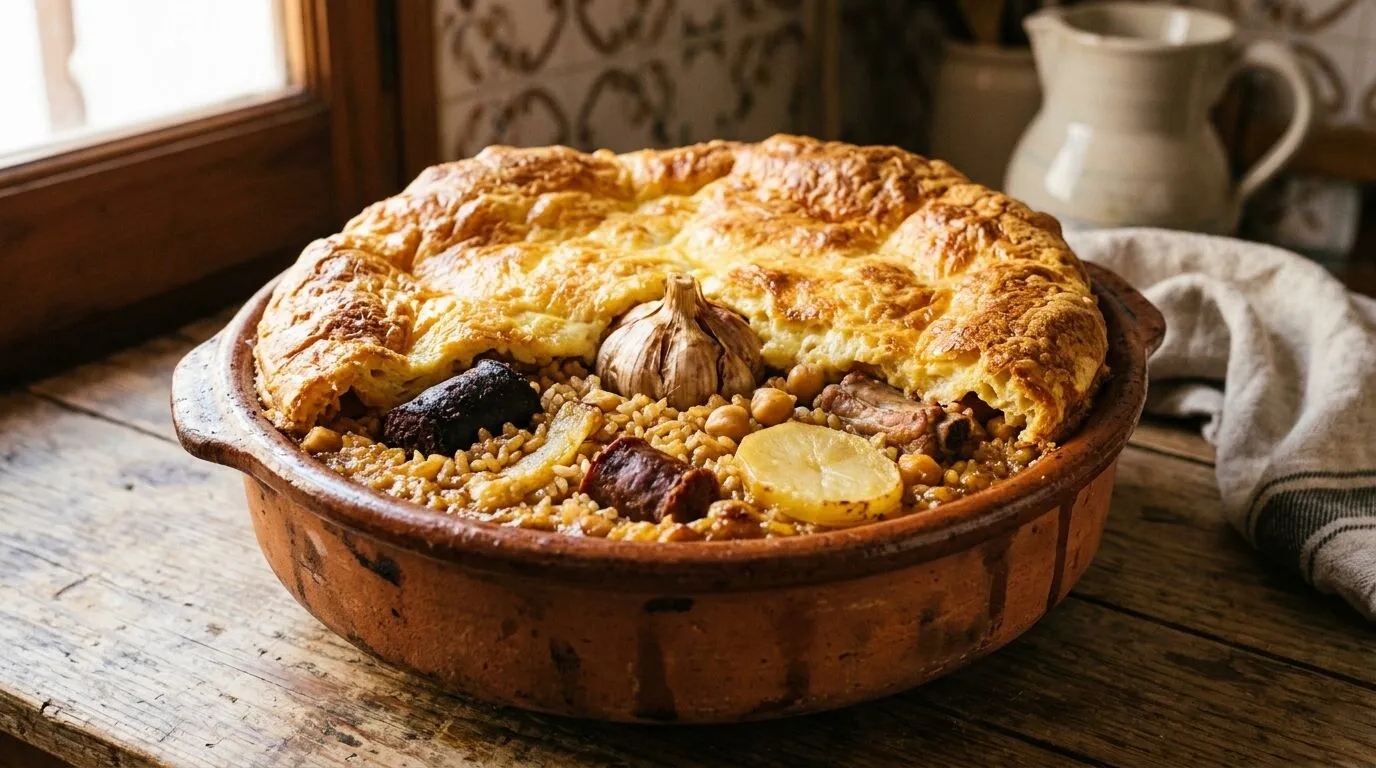

Arroz con costra (crusted rice)
Yield: 4 servings
Are there 40 or more of you? We cook rice dishes live for groups
Large paella pans need less liquid. Sources
Ingredients
Rice
- 320 gRice
- 2 lWater
- 0.5 gSaffron threads, toasted
- to tasteSalt
Meat and sausage
- 0.5 pcsRabbit
- to tasteChicken (optional)
- to tasteChickpeas (optional)
- 400 gAssorted fresh sausages
- 150 gExtra virgin olive oil
- 200 gGrated tomato
- to tasteThyme
- to tasteRosemary
costra
- 10 pcsEggs
- to tasteChopped parsley
Ingredients
Steps
- 1Season the 0.5 pcs (and the to taste, if you are using it) and brown it in 150 g until well browned. Take it out.
- 2Brown the 400 g, cut into pieces of about 2 cm, and set it aside: it goes on top at the end.
- 3In the oil that is left, fry the 200 g for a few minutes. You will know it is fried when it has darkened.
- 4In a separate pot put the 2 l, the meat, the to taste, the to taste, the to taste and the 0.5 g. Boil it for 20 minutes; if you can, leave it to rest for a couple of hours so the stock gains body.20 min
- 5In the earthenware pot put the meat, a couple of spoonfuls of the fried tomato, the to taste if you are using them and the stock: two parts to one of rice, up to a finger’s width from the rim in a 25 cm pot. When it boils, add the 320 g, season well and take it off after 8 minutes, with the grain still hard.8 min
- 6Take the pot off the heat. Put the fried sausage on top, and the 10 pcs beaten with salt and to taste.
- 7Take it straight to the costrera with embers or to an oven preheated to 180 °C, until the egg rises like a soufflé: about 15 to 20 minutes.18 min
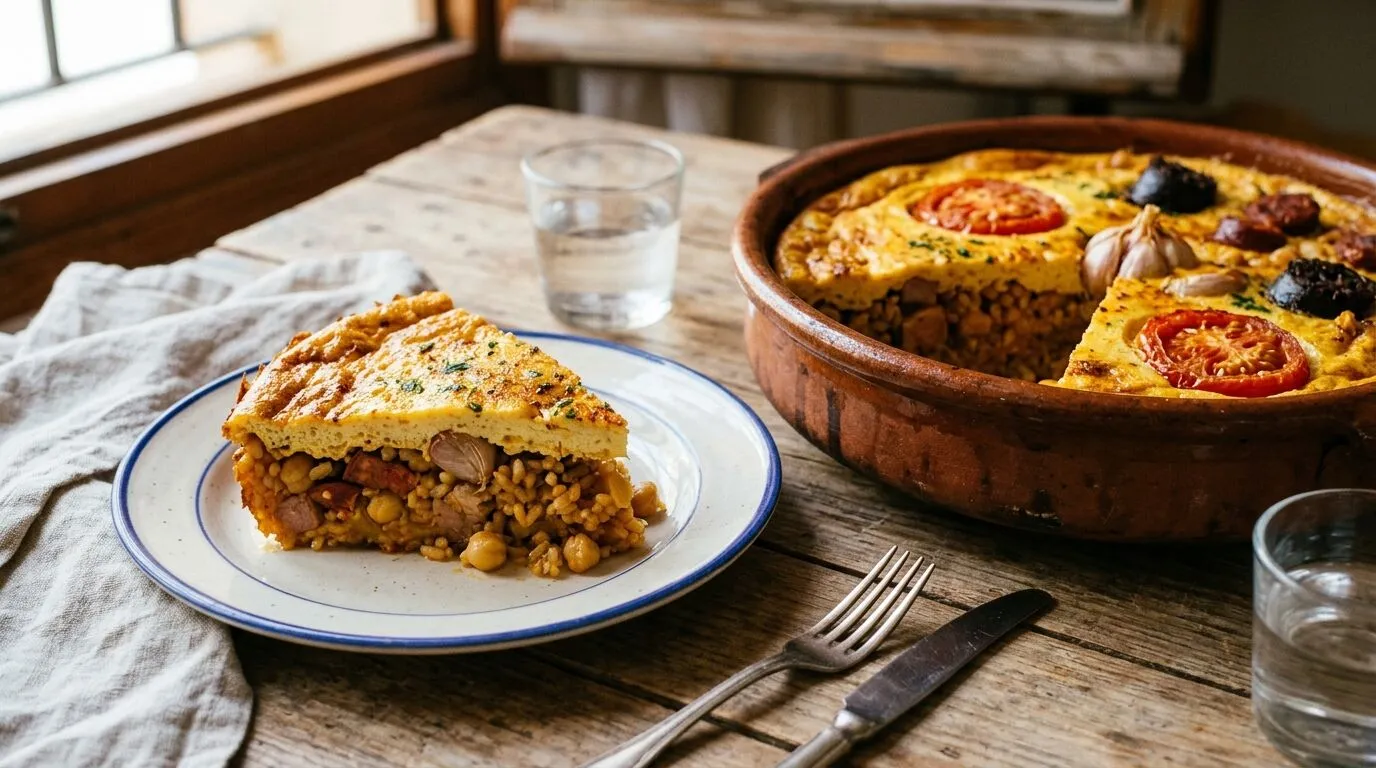
Two stages: a half-cooked rice
What makes this rice special is that it is cooked in two stages. First, about 8 minutes in the earthenware pot, while the grain is still hard. Then the beaten egg goes on top and the costrera or the oven sets it and finishes cooking the rice from underneath. The official recipe gives 15 to 20 minutes for that second stage, but the signal is something else: that the egg rises. The egg is in charge, not the clock. The history, origin and name are told in the glossary: arroz con costra. Here we get practical.
Earthenware pot, costrera or oven
The pot (perol) is earthenware and goes on the fire first and then under the costrera or into the oven. Over a wood fire, the costrera is a metal plate with embers on top, which sets the egg from above. In a home kitchen, the oven does the job: the Turisme Comunitat Valenciana recipe itself suggests it if you have no wood fire or costrera.
Here the sources disagree, and it is worth seeing that before you start. The oven is at 180 °C in the Turisme Comunitat Valenciana recipe, which is the basis of this one; at 215 °C in the Convega recipe book, from the Vega Baja; and at 200 °C for about 10 minutes in the Real Academia de Gastronomía recipe. The eggs don’t agree either: 10 for four servings in Turisme Comunitat Valenciana, 6 for four in Convega and 6 in the Real Academia, but for six people. These are different recipes from different homes, and none is “the standard”: start with the base of this recipe and adjust to your oven, watching how the egg rises.
Sausage and meat
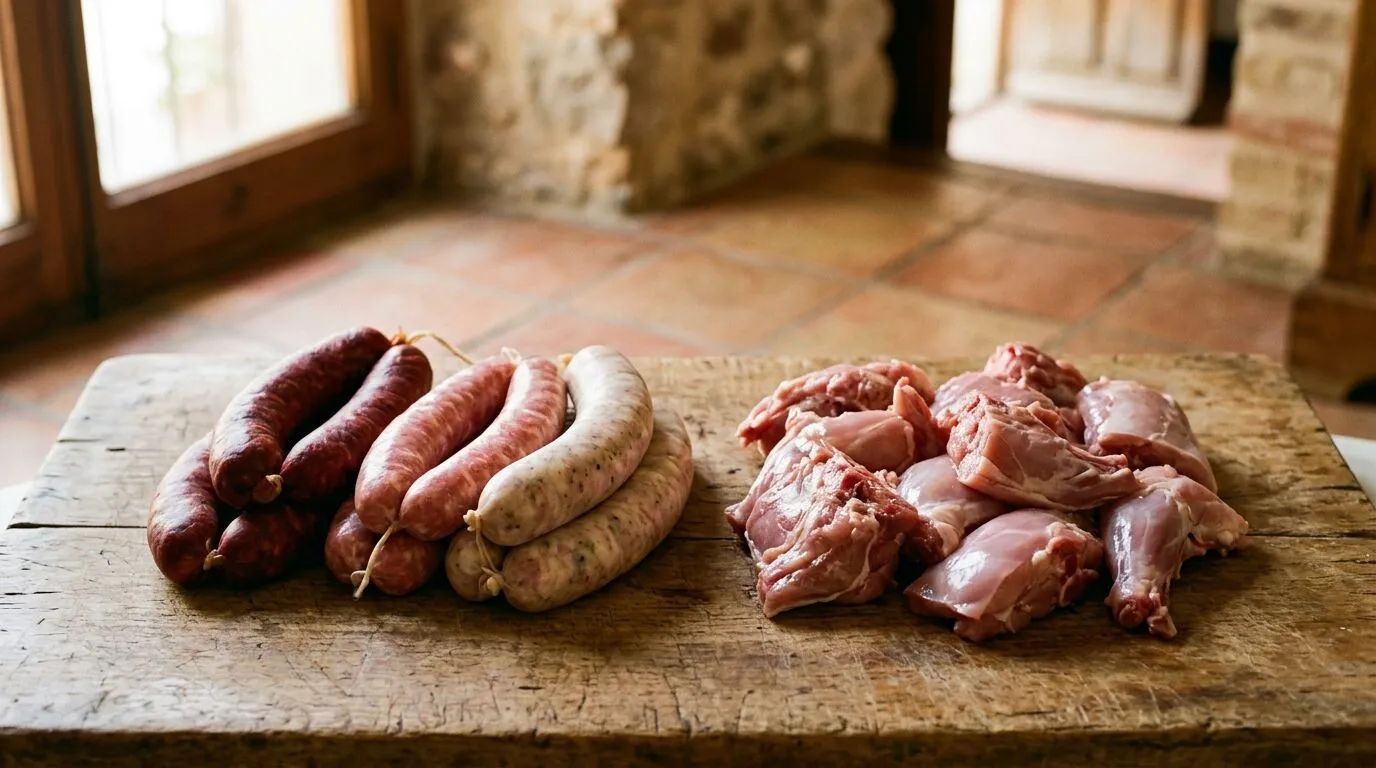
The official recipe asks for rabbit, 400 g of assorted fresh sausages and, as optional extras, chicken and chickpeas. Convega spells out the sausages: red longaniza, white sausage, blanco and black morcilla. The Real Academia adds white and black butifarra, longaniza, chicken and rabbit, and makes the chickpeas a fixture. There is no single combination: what doesn’t change is the egg. The cocido con pelotas of the Vega Baja comes from the same Convega recipe book.
The sausage is browned separately, in pieces of about 2 cm, and goes on top of the rice at the end, under the egg. The meat, on the other hand, goes inside: first it flavours the stock and then it goes into the pot with the rice.
The stock and the timings
The stock is made separately: water with the meat, thyme, rosemary, salt and toasted saffron, boiled for 20 minutes. The official recipe recommends, if you can, letting it rest for a couple of hours so it gains body. Then it goes into the pot with the meat and a couple of spoonfuls of the fried tomato, and is measured: in a 25 cm pot, until a finger’s width is left to the rim. With that measure, the official recipe counts two parts of stock to one of rice, which is also the Real Academia de Gastronomía’s; Convega counts two and a half glasses of water per glass of rice.
The total time in the recipe is 1 hour 30 minutes for four people, most of it before the rice goes in: this is a recipe made without hurry.
Typical mistakes
- Overcooking the rice in the pot. It comes off with the grain hard at 8 minutes and should stay that way: it finishes under the crust. If it cooks longer, it arrives overdone.
- Over-beating the eggs. Convega warns that they should be beaten well mixed, but without overdoing it.
- A very thin crust. Choose a pot that isn’t too wide, so the egg has thickness and rises.
- Burning the egg. It has to rise and turn golden; that is why you watch the oven or the costrera until it rises like a soufflé.
So everyone can sit down
This recipe makes four servings; if there are more of you, the recipe card scales the quantities, and for working it out for big groups there is how much rice per person. If you like rabbit, see the rice with rabbit and snails, and for another casserole-and-oven rice, the baked rice. The toasted bottom of a paella, which is not this, is explained in socarrat.
If there are 40 or more of you and you want rice cooked in front of everyone, we cook rice for groups live. And if the fiesta is in Elche, there is our catering in Elche.
History and variations
It is a celebration dish of the province of Alicante and, according to Convega, a weekend one. Turisme Comunitat Valenciana places it in Elche, Pego, Torrevieja and Orihuela, and the Convega recipe book calls it “arroz y costra” and considers it very typical of the Vega Baja del Segura. The origin and the name are in the glossary.
el Baix Segura: Convega (Vega Baja) calls it “arroz y costra” and uses 6 eggs and an oven at 215 °C. The Real Academia de Gastronomía bakes at 200 °C for about 10 minutes. Sources
Tips
The rice comes off the heat with the grain still hard: it finishes cooking under the egg, in the oven or under the costrera. Sources
Measure the stock in the pot: in one 25 cm across, until a finger’s width is left to the rim. Sources
Beat the eggs with a fork, well mixed but without overdoing it: if they are over-beaten, the crust doesn’t rise as it should. Sources
The crust shouldn’t be very thin: choose a suitable, narrower pot so the egg rises. Sources
Arroz con costra (crusted rice)
Frequently asked questions
How do you make arroz y costra the Orihuela way?
With the recipe from the Vega Baja, the Orihuela area, collected in the Convega recipe book: the sausages are fried and set aside, the meat is cooked with tomato and saffron water, and the rice goes in for about 10 minutes. The sausage goes on top, it is covered with six beaten eggs and goes into an oven preheated to about 215 °C for 10 minutes, until the egg forms a crust.
Can you make arroz con costra in a home oven?
Yes. The Turisme Comunitat Valenciana recipe itself suggests the oven if you have no wood fire or costrera: preheated to 180 °C, for 15 to 20 minutes, until the egg rises like a soufflé. Convega goes hotter, to about 215 °C, and the Real Academia de Gastronomía to 200 °C. Use an earthenware pot that can go in the oven and watch the egg rather than the clock.
What food is Elche known for?
If we are talking about rice dishes, arroz con costra. Turisme Comunitat Valenciana lists Elche among the towns where it is made best and says that in many of them it is the celebration dish par excellence; for the video of its recipe it went to a restaurant in Elche. And at the August fiestas, on the 10th, Elche holds an arroz con costra competition on the same day as the giant paella, according to Alicante Plaza.
Sources
- Arroz con costra, Turisme Comunitat Valenciana (recipe PDF)
- Arroz con costra, Turisme Comunitat Valenciana (recipe page)
- Arroz con costra, Mediterráneo en Acción (Turisme Comunitat Valenciana, Restaurante Cachito, Elche)
- Vega Baja recipe book, recipe 7: arroz y costra (Convega)
- Arroz con costra (serves 6), Real Academia de Gastronomía
- Fiestas de Elche: culture, heritage, gunpowder and gastronomy (Alicante Plaza)
Glossary terms
Recipes
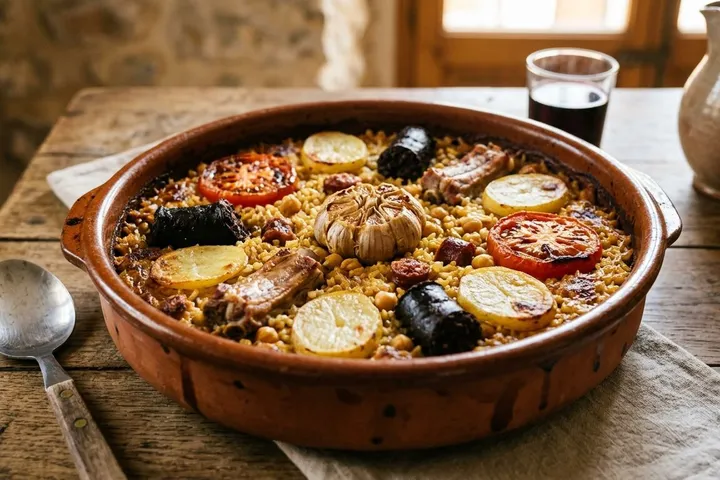
Valencian baked rice
Baked rice, or arròs al forn, is a dry earthenware-dish rice with pork ribs, black pudding, chickpeas and potato, finished in the oven until golden.
Total time: 25 min
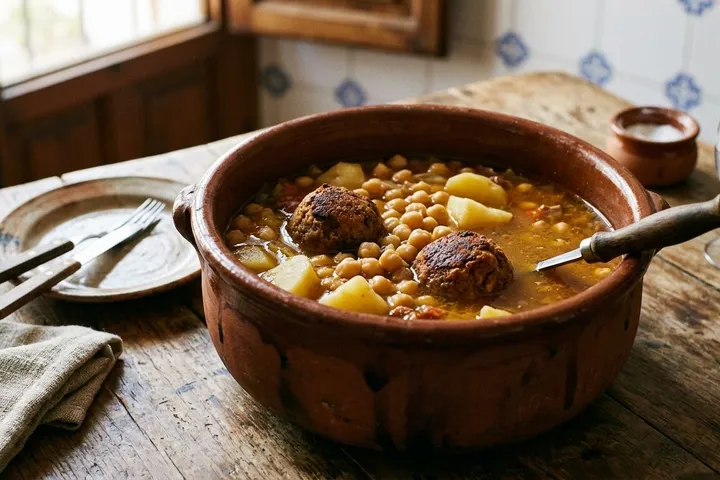
Cocido con pelotas
Winter stew from the Vega Baja: meat in cold water, soaked chickpeas, one potato and one or two pelotas per person, and the broth with a squeeze of lemon.
Total time: 1560 min
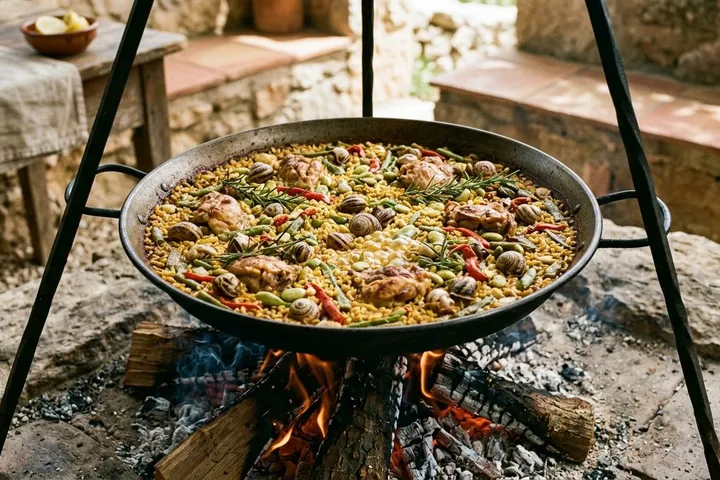
Rice with rabbit and snails
Rice with rabbit and snails is a countryside rice from inland Alicante: fried rabbit, purged snails and a fire of vine prunings, as in Monóvar.
Total time: 60 min
Served at…
- Arroz con costra competition (10 August, Elche fiestas) · Sources