How much rice per person for paella? 100 g of dry rice for a Valencian paella, or one kilo for every ten people. That’s the quantity in the Spain.info paella recipe and the one master rice cook José Luis Berlanga uses. With that figure and the table below, which runs from 10 to 200 guests, you can work out the shopping for a paella for 20, 50 or 100 without reaching for a calculator.
What shifts that figure is the type of rice, what’s eaten beforehand and who’s sitting at the table.
The 100-gram rule: what you weigh and why
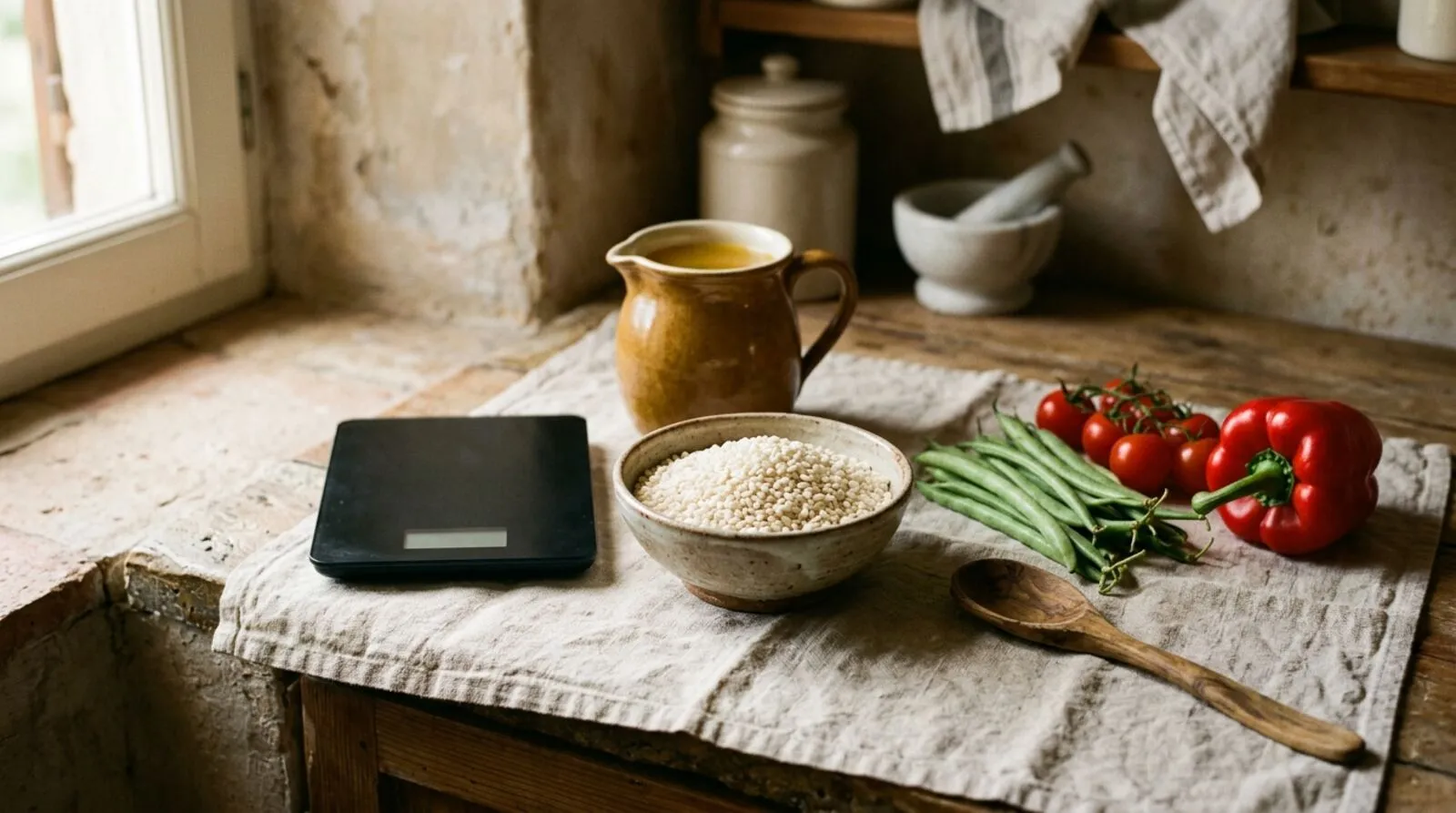
You weigh the rice raw. The finished dish weighs a lot more, because the grain soaks up the stock and the meat and vegetables go on top, so it’s no good for your sums. And use scales: no two handfuls are the same.
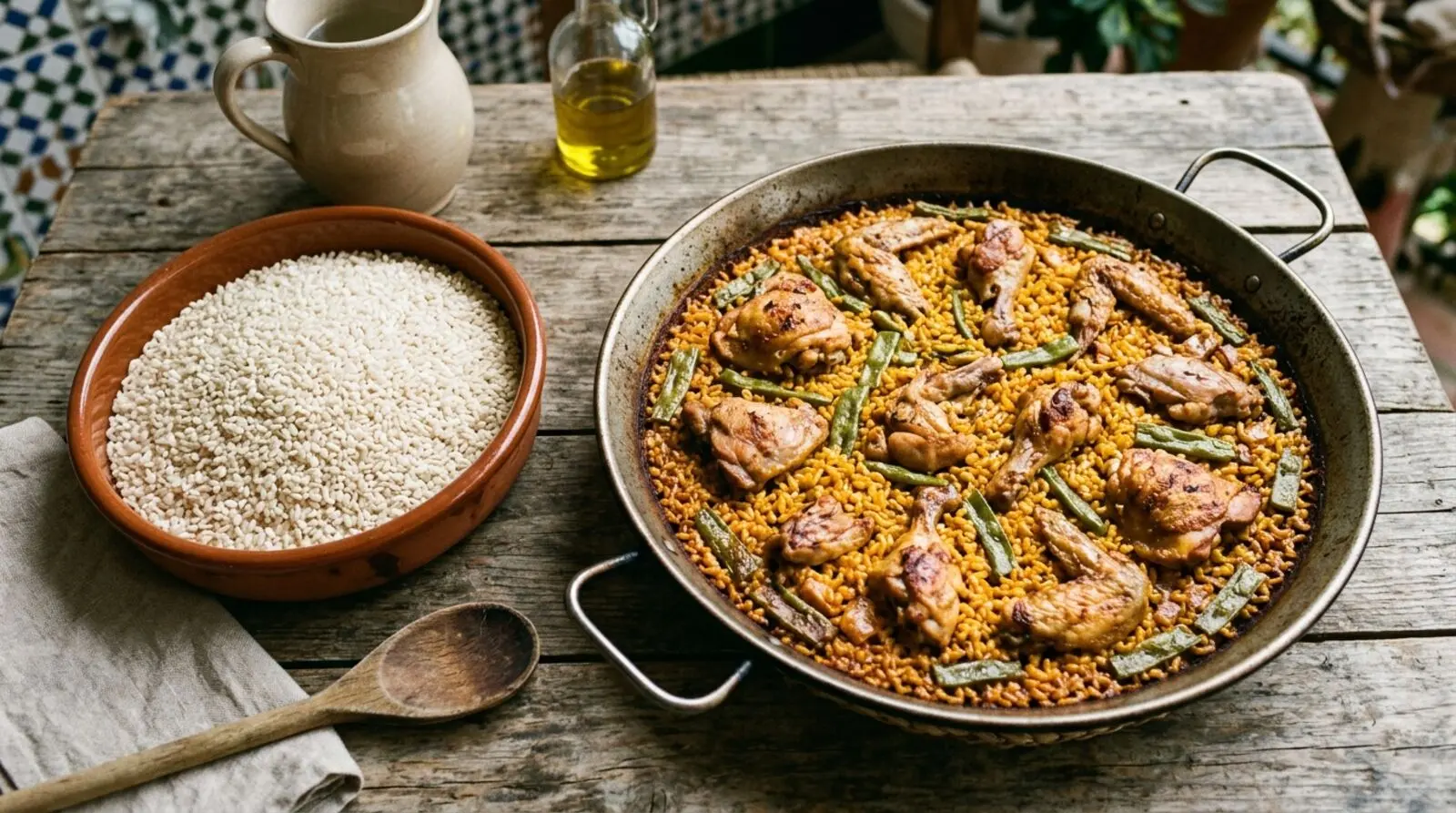
Why 100 g and not 150? Because a Valencian paella is packed with chicken, rabbit, green beans and garrofón (a large, flat butter bean). As Berlanga puts it, 100 g is enough “because it’s got plenty of bits in it”. The rice is the base of the dish, not the whole dish. And the rice you’re now counting in grams has a long story behind it: where paella rice comes from.
How much rice per person by type of rice
The less there is in the pan alongside the rice, the more rice each person needs. These are Berlanga’s quantities:
- Valencian paella: 100 g per person.
- Arroz a banda (rice cooked in fish stock, with the fish served separately): 110 g. There are fewer bits in it, so the rice is the star.
- Soupy rice (arroz caldoso): 50 g, a handful. The stock fills the plate and the rice goes twice as far.
If you’re making two or three different rice dishes, work out each one with its own portion size and only for the people who’ll be eating it. A soupy rice and a Valencian paella don’t go into the same sum. If you want to see how each one is cooked, the recipe section has our Valencian paella recipe, the arroz a banda recipe and the brothy rice with chicken and rabbit.
Paella rice table for 10 to 200 people
Find your number of guests in the first column and read across to the kilos of dry rice under the dish you’re making. Only count people having rice as their main course.
| Guests | Valencian paella (100 g/person) | Arroz a banda (110 g/person) | Soupy rice (50 g/person) |
|---|---|---|---|
| 10 | 1 kg | 1.1 kg | 0.5 kg |
| 20 | 2 kg | 2.2 kg | 1 kg |
| 30 | 3 kg | 3.3 kg | 1.5 kg |
| 40 | 4 kg | 4.4 kg | 2 kg |
| 50 | 5 kg | 5.5 kg | 2.5 kg |
| 60 | 6 kg | 6.6 kg | 3 kg |
| 80 | 8 kg | 8.8 kg | 4 kg |
| 100 | 10 kg | 11 kg | 5 kg |
| 150 | 15 kg | 16.5 kg | 7.5 kg |
| 200 | 20 kg | 22 kg | 10 kg |
Your number isn’t there? Multiply the guests by the grams in the right column: 25 people having Valencian paella need 2.5 kg; 70 having arroz a banda, 7.7 kg.
Paella for 50 people: the full shopping list
For a Valencian paella for 50 you need 5 kg of rice. Scale up the Spain.info recipe, which serves ten, five times over and the list looks like this:
| Ingredient | For 10 (Spain.info) | For 50 people |
|---|---|---|
| Rice | 1 kg | 5 kg |
| Chicken | 2 kg | 10 kg |
| Rabbit | 1 kg | 5 kg |
| Green beans | 500 g | 2.5 kg |
| Garrofón (butter beans) | 250 g | 1.25 kg |
| Tomato | 300 g | 1.5 kg |
| Olive oil | 0.3 l | 1.5 l |
| Paprika | 6 g | 30 g |
| Water | 3.5 l | about 17.5 l (go a little under; see below) |
Saffron and salt to the cook’s taste. For 50 guests you won’t be cooking in a single domestic paella pan: the practical thing is to split those 5 kg across two or three pans, each on its own burner.
For 100 or 200 people, the same rule
The rice scales the same way: 10 kg for a hundred, 20 kg for two hundred. What changes is everything else, because now you’re talking about several burners, space and a system for serving. We go through it step by step in how to organise a paella for 100 people.
How much stock the rice needs
There’s more variation here than with the grams. Berlanga’s starting point is two parts stock or water to one part rice. Bomba rice takes more liquid and comes close to three parts; Albufera rice goes up to four. If it’s a fish rice, that stock is usually a fumet: you’ll find how to make fish fumet in the recipe section.
The Spain.info recipe frames it differently: 3.5 litres of water per kilo of rice, but that water first simmers with the meat to make the stock in the pan itself, and a good part of it evaporates. That’s why it can’t simply be compared with Berlanga’s ratio.
With big groups there’s one thing worth knowing. In a large pan the layer of rice is thinner and the stock evaporates faster, so you can cut back on the liquid. Blindly multiplying the proportions from your Sunday paella usually ends in overcooked rice. And if you change variety, change the stock too.
When to cut or increase the portion
The 100 g is your benchmark. These are the situations that shift it:
- Hearty starters. After cured meats, croquettes and salad, people eat less rice. You can cut back a little.
- A filling second course or pudding. Same again.
- The paella is the whole meal. Stick to 100 g and expect someone to go back for seconds.
- Children. It depends a lot on their age and how hungry they are, so don’t automatically allow half a portion. Count them separately and, if there are lots of them, ask their families.
- Guests having a different dish. Anyone eating separately (vegetarian, gluten-free, allergies) isn’t included in the shared rice.
- Maybes. Only count people who’ve confirmed.
How to get the headcount right
Nearly every miscalculation comes down to who’s been counted, not the grams. Before you shop, make three lists:
- Who’s having rice as their main course. These are the people who go into the table.
- Who’s eating something else. Special menus, allergies, people who are only coming for the nibbles beforehand.
- Who’s working and eating too. Cooks, waiting staff, organisers. They’re always forgotten and they always eat.
Write the date of the latest headcount next to the total. If numbers change, you’re correcting one clear figure rather than three WhatsApp voice notes. And ask for final confirmation in good time: a change on the day leaves you with the rice already bought.
Common mistakes when working it out
- Weighing the cooked rice. Rice swells as it cooks; always work in dry weight.
- Going by the size of the pan. Just because more fits doesn’t mean it’ll turn out well: the rice needs to sit in a thin, even layer.
- Multiplying the stock from your home recipe. In large quantities it needs adjusting, as you’ve seen above.
- Adding 20% “just in case”. Without a specific reason, all you get is leftovers. Better a deliberate margin, for instance for the people who’ll go back for seconds.
- Measuring with cups or ladles. Fine for four; for fifty, use scales.
Big groups: several pans beat one giant one
From about forty people, the usual approach is to split the rice across several paella pans. Each one cooks its own even layer, the heat is easier to control and you can start serving as soon as the first one’s ready. It also lets you offer two or three rice dishes at once, which is usually what people fancy at a group lunch.
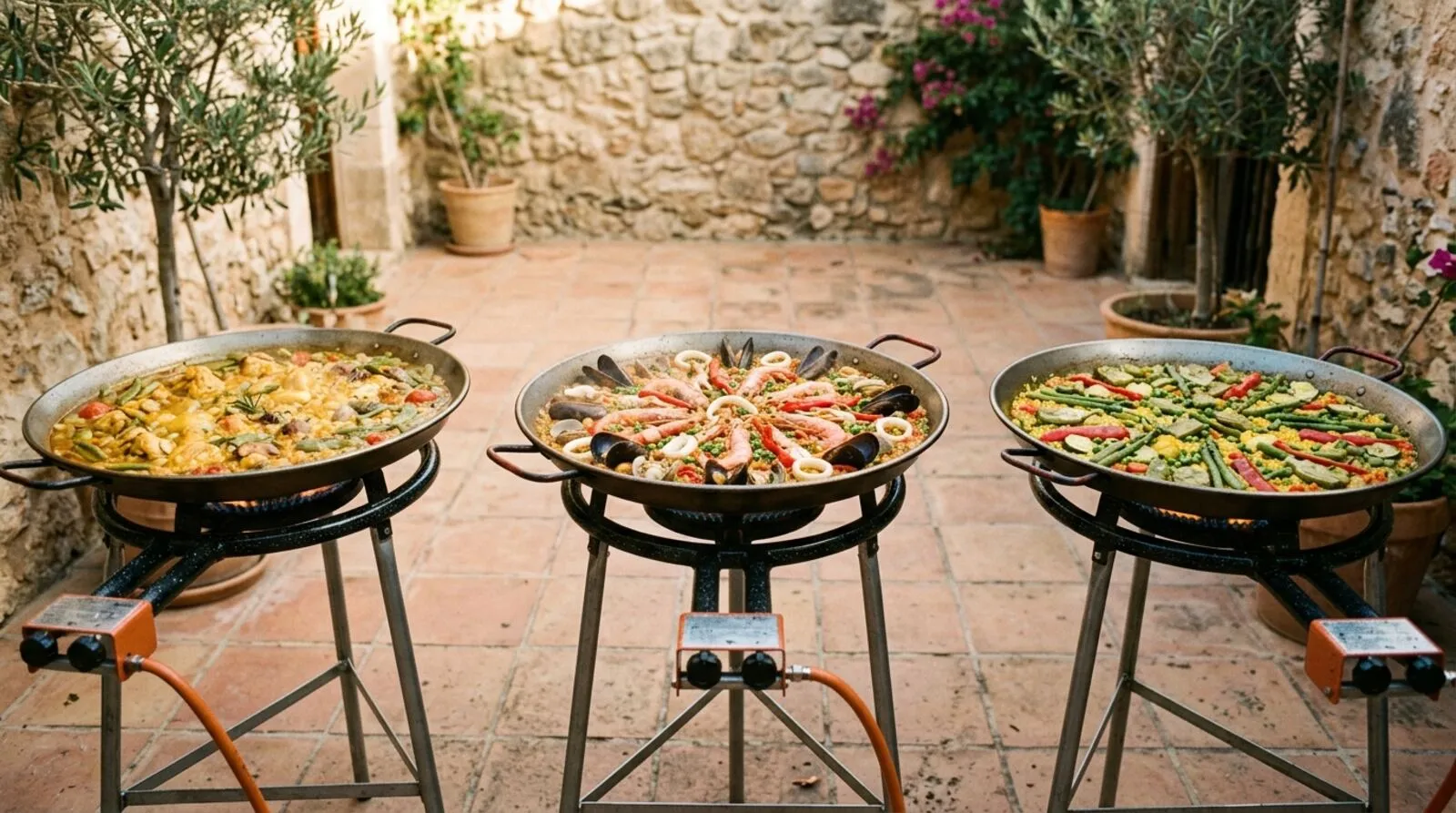
If you’d rather have one enormous pan as the centrepiece of the party, that’s a different set-up: see our giant paella for fiestas and events. And if you like the idea of the rice being cooked in front of your guests, we explain how it works in what is show cooking. At Xepep we’ve been cooking for four generations, and our paella and show cooking service caters for groups from 40 people and can serve up to 500.
The next step
With your guest numbers, the type of rice and the table, your shopping list is done. What’s left is deciding where it’ll be cooked and how it’ll be served: start with our guide to paella for 100 people or, if you’d rather we thought it through with you, get a quote for your event with the date, the place and how many of you there are.
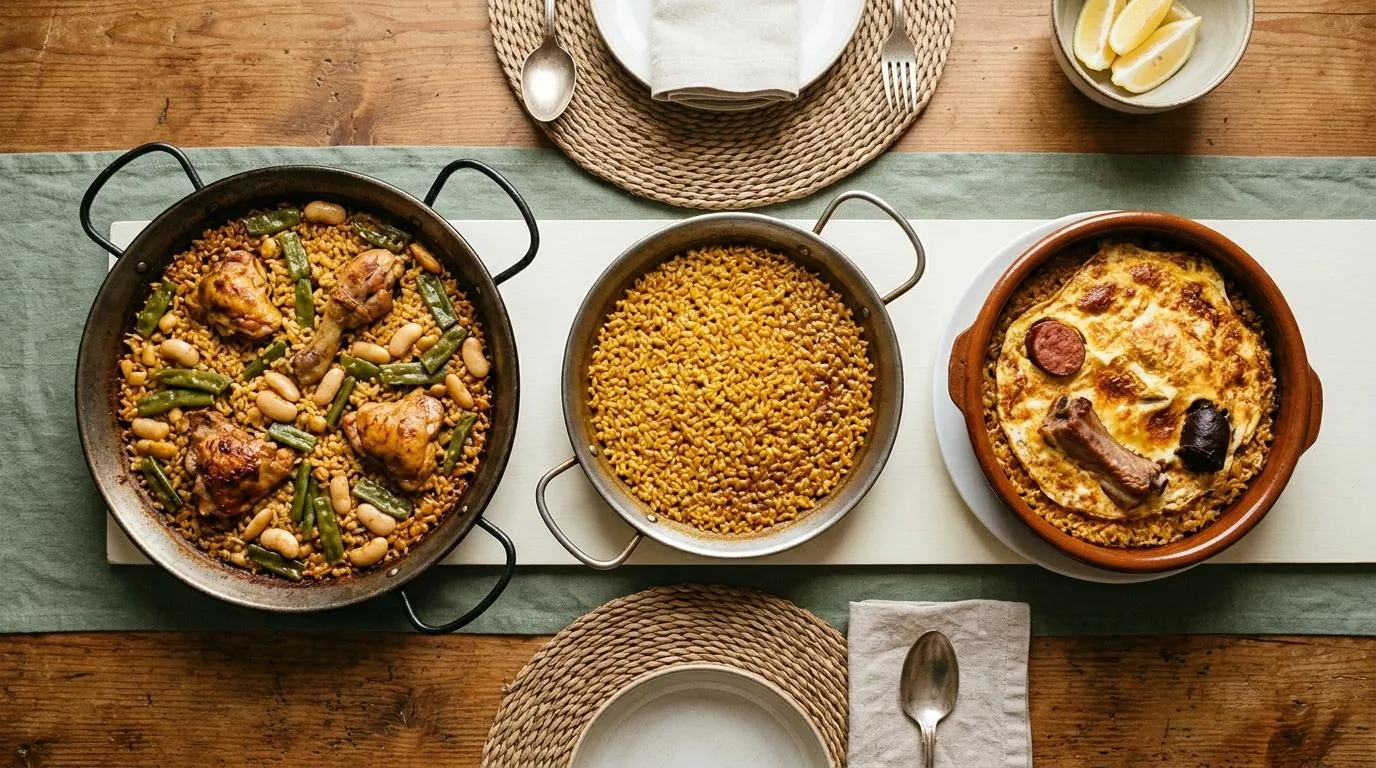
Before calculating quantities, compare paella, arroz a banda and egg-crust rice.