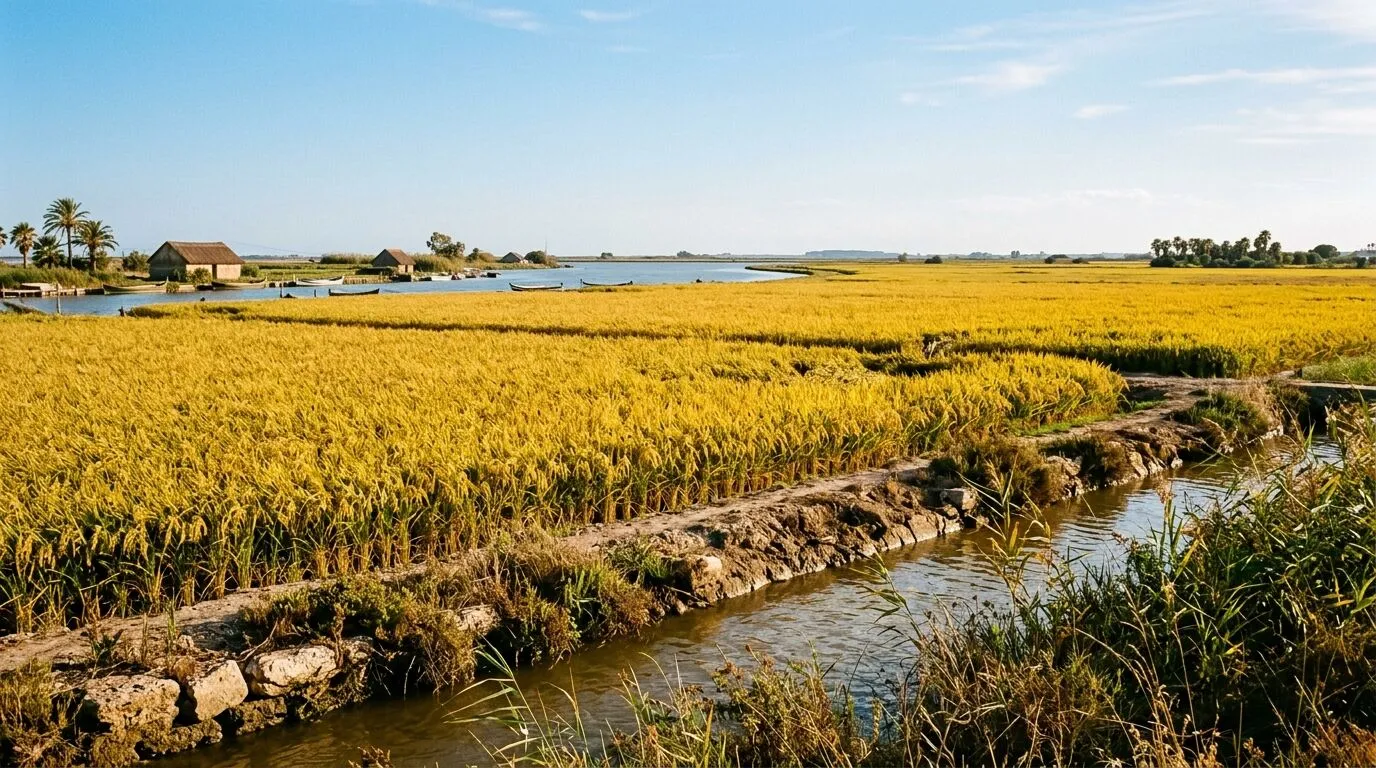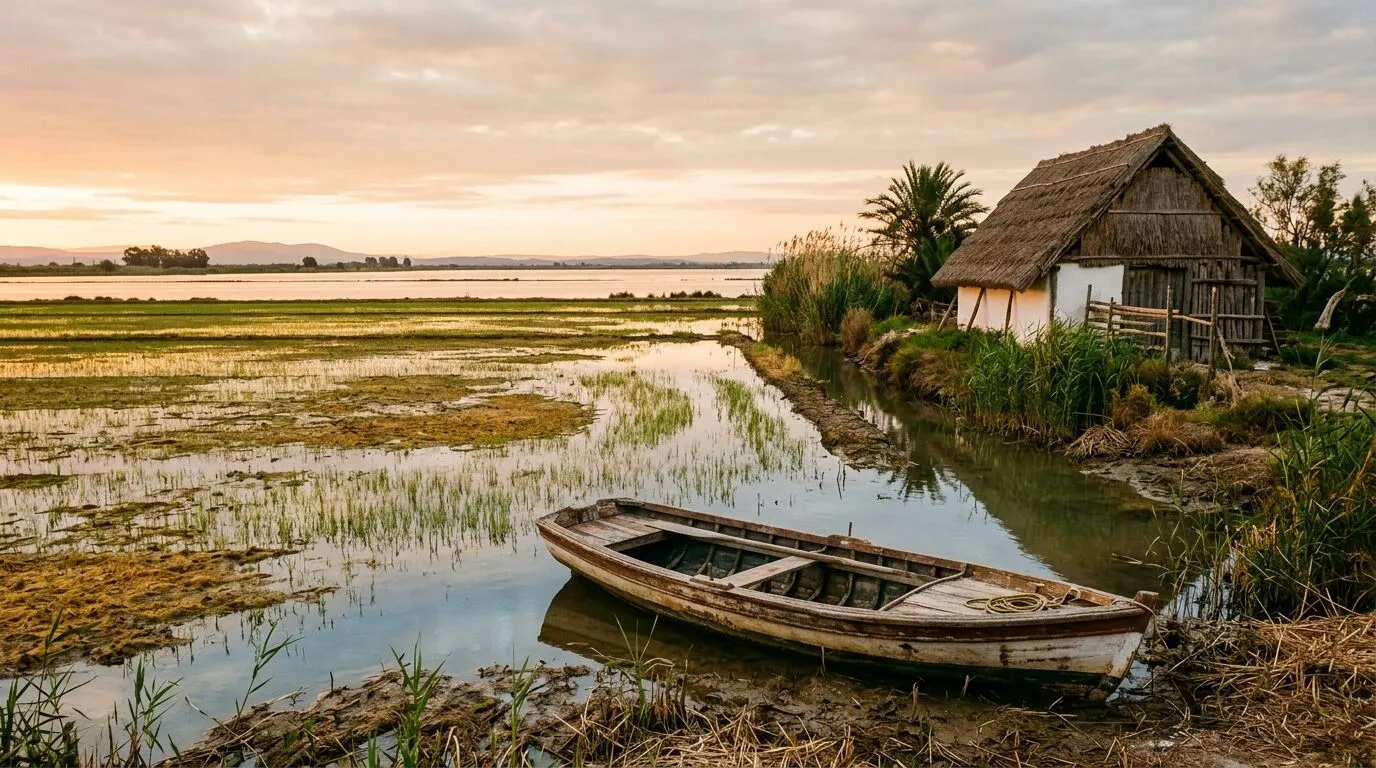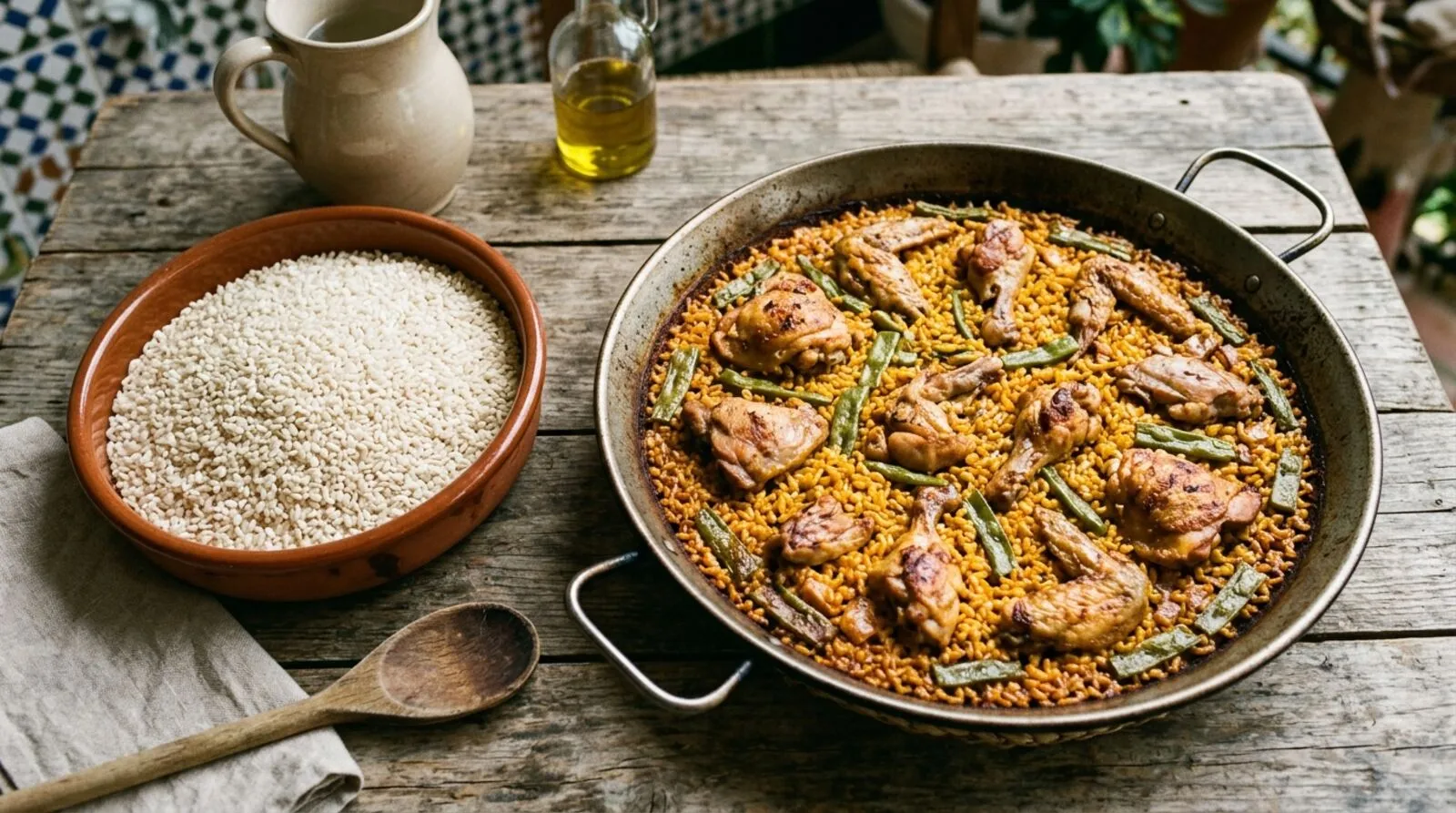
Paella valenciana is a dry rice dish of chicken, rabbit, flat green beans and garrofó (a large, flat white bean), with tomato and saffron, cooked in a paella pan over an open flame. It was born around the Albufera lagoon in Valencia and has no seafood and no chorizo: mix meat and seafood and you have a paella mixta, which is a different dish. Since 2021 it has been protected as intangible cultural heritage (Bien de Interés Cultural Inmaterial).
What really goes into paella valenciana
In 2022 the Catholic University of Valencia presented a study of nearly 400 home cooks, all over 50, from the 266 towns and cities of the province of Valencia. Ten ingredients were used by more than 90% of them (rabbit by 88.9%):
| Base | Vegetables | Meat | Colour and flavour |
|---|---|---|---|
| Rice, water, olive oil, salt | Tomato, flat green beans (bajoqueta), garrofó | Chicken and rabbit | Saffron (or food colouring) |
They also found 38 regular extras and 50 occasional ones. The most common: paprika (62.5%), rosemary (52.2%) and artichoke (46.3%).
What changes from one area to another
There’s only one paella valenciana, but every district has its own accent. Wikipaella, which works with the recipes of the restaurants it recognises, lists these variations:
- Mountain snails: an optional third protein.
- Artichoke: standard in the province of Castellón and in some towns in l’Horta Nord, north of Valencia.
- Pork ribs: common in some towns in Castellón, where they often replace the rabbit.
- Garlic: used in some parts of the Valencia region.
- Paprika: a teaspoon is typical.
What you won’t find in these benchmark recipes is seafood or chorizo. A paella that combines meat and seafood is called mixta: perfectly respectable as a dish, but it isn’t paella valenciana. Neither is seafood paella or arroz a banda: they’re other rice dishes, with names of their own.
Origins and history
It was born around the Albufera lagoon in Valencia as food for farmers and market gardeners, and by the late 19th century it had moved from farm cottages to beachside eateries, from the Malvarrosa to the Albufereta in Alicante. Rice had been there for centuries: the Arabs improved irrigation and, because of malaria, the bans followed. Among the first royal ones is that of Peter the Ceremonious (Pere el Cerimoniós), who at the Corts (parliament) of 1342 ordered the paddy fields eradicated in the town of Castelló; Martí I extended the ban to the whole kingdom in 1403. The full story, with a timeline, is in our history of paella and rice in Spain.
How it’s eaten and how to spot the real thing
It’s a dry rice, cooked in a thin layer, with separate grains and socarrat on the bottom. It’s built on a sofrito of meat, vegetables and tomato, made with water rather than ready-made stock, and with a short-grain rice such as bomba. The customs recorded in the decree can still be seen in any town or village:
- The rice is scattered in a cross over the liquid and then left unstirred.
- Orange wood is the favourite fuel: it adds aroma and gives a fire that’s easy to control.
- Everyone eats straight from the pan, each from their own section, and traditionally with a spoon.
“The art of bringing people together and sharing”
Decree 176/2021 of the Valencian government (the Consell) declared paella valenciana intangible cultural heritage under that motto, and Spain’s official gazette (BOE) published it on 15 March 2022. It doesn’t protect a fixed recipe: it protects the social custom of cooking it and sharing it, from Sunday family lunches to local fiestas. As for what goes in, it leaves just one thing beyond debate: “the one essential ingredient: rice”.
Paella valenciana at your event
If your group wants paella valenciana, tell us when you ask for a quote. At Xepep we cook rice live for 40 people or for 500 in a single service – see paella catering and show cooking. To work out quantities, have a look at how much rice per person and our guide to paella for 100 people.
For more vocabulary from the table and the fiesta, explore Saffron.
How to make it
Traditional Valencian paella recipeSources
- Decreto 176/2021, de 29 de octubre, del Consell, BIC inmaterial de la paella valenciana «el arte de unir y compartir» (BOE, 15 March 2022)
- Research confirms the ten essential ingredients of “authentic” paella valenciana (Valencia Plaza, on the UCV study)
- Ingredients of paella valenciana (Wikipaella)
- Paella recipe (Spain.info, Turespaña)
- Alicante, gastronomía y producto (Turismo de Alicante, 2022)
- Arròs (Gran Enciclopèdia Catalana): Pere el Cerimoniós’s 1342 privilege against paddy fields
- Parra Villaescusa (2013), El cultivo del arroz en Orihuela a finales de la Edad Media (Rice growing in Orihuela at the end of the Middle Ages), Medievalismo 23: the bans from 1342 to 1403