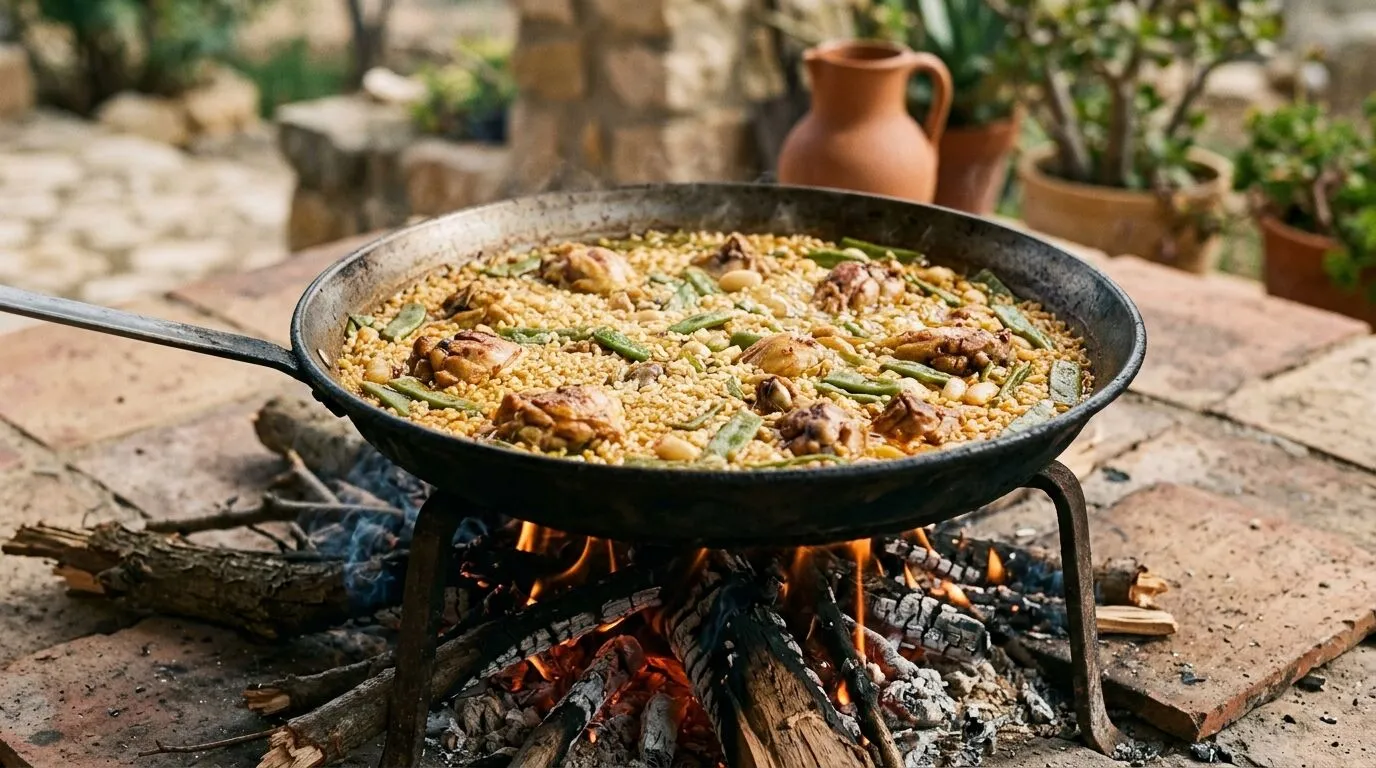

Valencian paella
Yield: 4 servings
Suggested paella pans: 1 × 40 cm Glossary
Are there 40 or more of you? We cook rice dishes live for groups
Large paella pans need less liquid. Sources
Ingredients
Sofrito
- 120 mlExtra virgin olive oil
- 480 gChicken, jointed
- 320 gRabbit, jointed
- 200 gFlat green beans
- 1 tspSweet paprika
- 2 pcsRipe tomato, grated
caldo y arroz
- 2.6 lWater
- 30 gSalt
- 24 pcsGarrofó (butter beans)
- 32 pcsSaffron threads
- 400 gRound-grain rice
- 1 sprigRosemary (optional)
Ingredients
Steps
- 1In a 42–55 cm paella pan, heat 120 ml and fry 480 g and 320 g over a medium heat, taking care to seal the meat well.
- 2Add 200 g and fry it together with the meat.
- 3Lower the heat, add 1 tsp and stir it so it doesn’t burn; after a few seconds, add 2 pcs.
- 4When the tomato is well fried, pour in water up to triple the volume of the rice and note the height it reaches in the pan. Then top up with the rest of the 2.6 l.
- 5Add 30 g and 24 pcs, and the *tavella* beans or the snails if you are using them. Let it boil over a medium heat so a stock forms.
- 6When the stock has dropped to the mark you took, add 32 pcs and spread 400 g all over the pan.
- 7Boil the rice for 5 minutes over a high heat, 5 over a medium heat and the last 5 to 8 over a very low heat. If you like, add 1 sprig.18 min
- 8Turn off the heat and let the paella rest for 5 minutes before serving.5 min
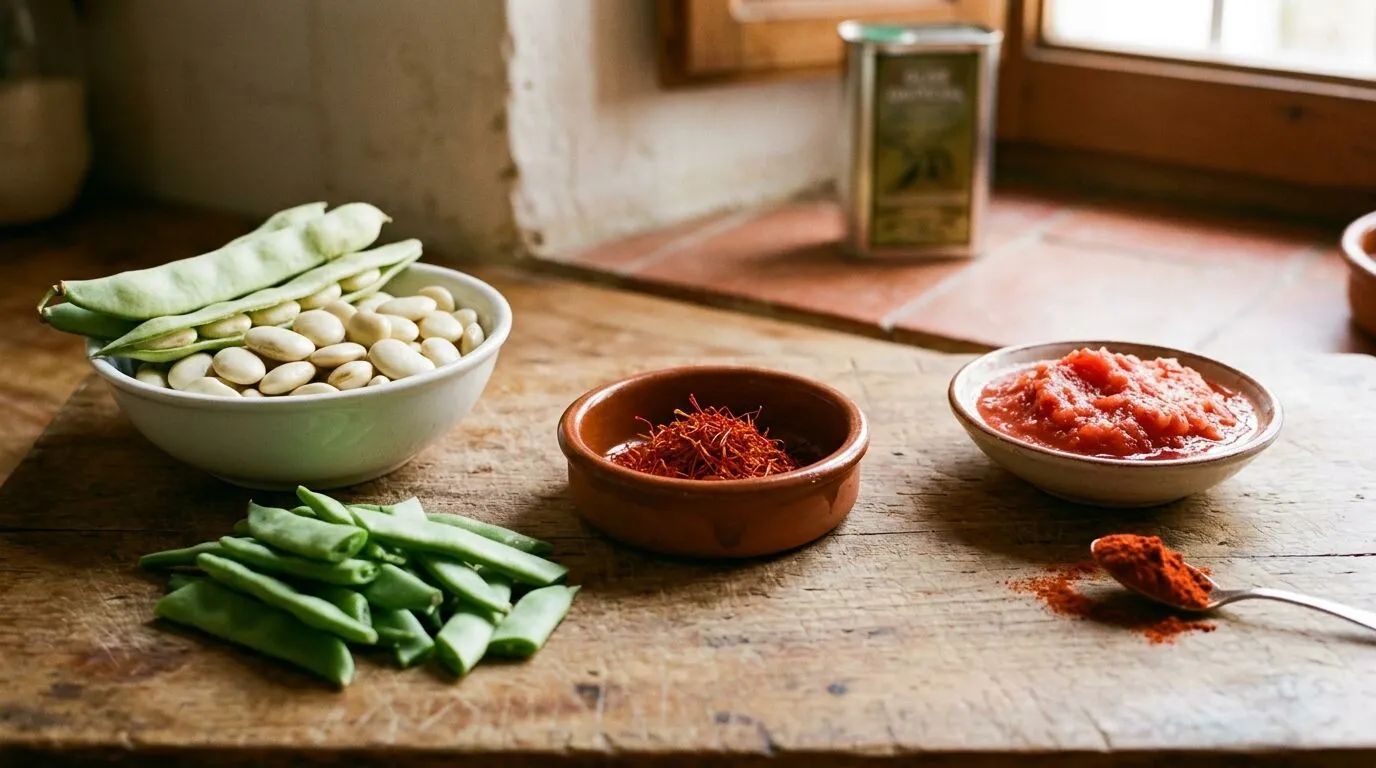
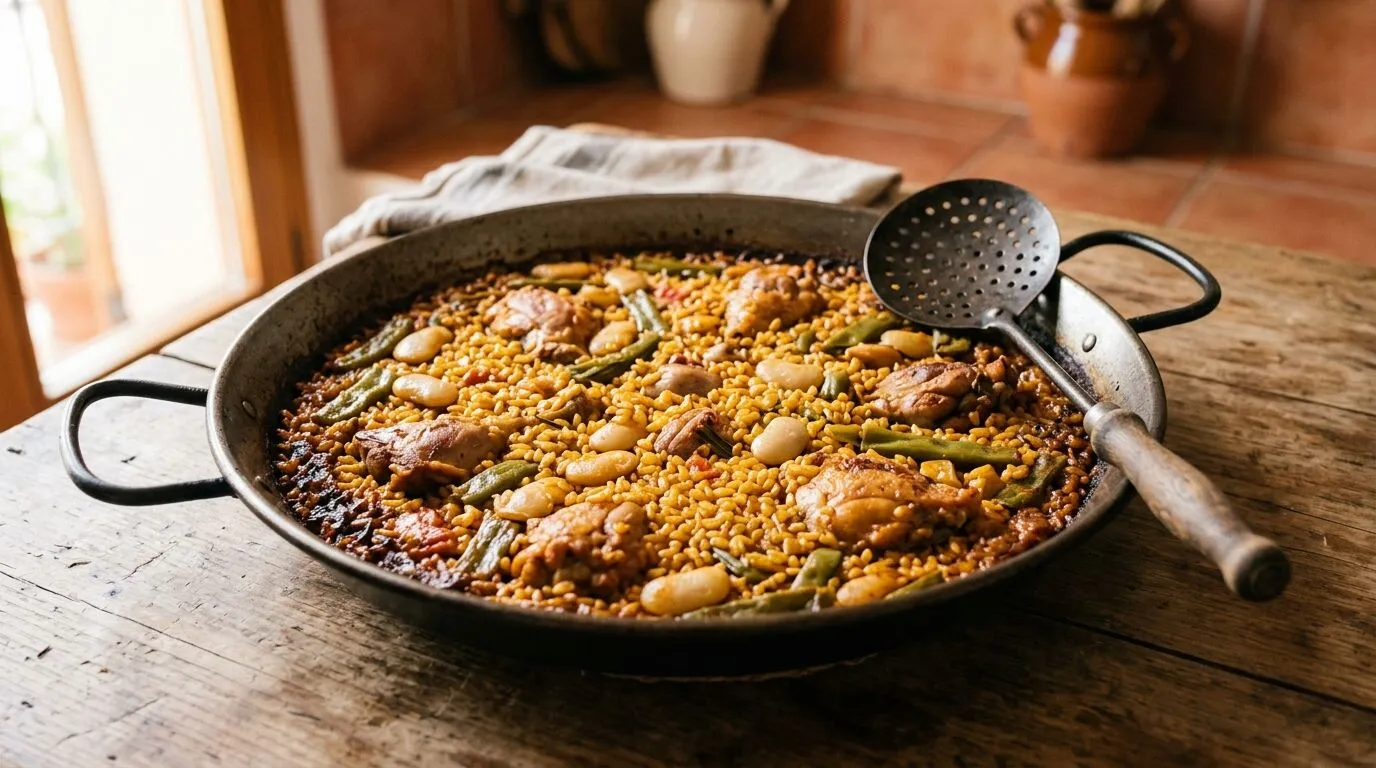
Valencian paella is cooked in a paella pan with rice, chicken, rabbit, flat green beans and garrofó, and you can spot it at a glance: loose grains, a thin layer, a saffron colour and a toasted crust on the bottom. What goes in it, where it comes from and what changes from one district to the next is covered in what Valencian paella is. Here you get the practical side: how to make it properly. The long story, from Moorish rice to the beach restaurant, is in our history of paella and rice in Spain.
What Decree 176/2021 says and what it leaves open
Decree 176/2021 of 29 October, of the Consell, declared “Valencian paella, ‘the art of uniting and sharing’” an intangible asset of cultural interest; the BOE (Spain’s official gazette) published it on 15 March 2022. It helps to know what it protects. The decree sets neither a recipe nor a closed list of ingredients: it says that its preparation “has several variants across the territory of the Comunitat Valenciana” and that the recipe “has never been free from controversy”. Only one ingredient is beyond dispute: “there is no doubt about the essential ingredient: rice”.
What it does record are practices: scattering the rice over the stock “drawing a cross”, in a thin layer if the number of guests allows it, and the recommendation not to stir it. And it makes clear that, whether you cook over wood or not, “the decisive and most delicate moment is the point at which the rice is cooked”.
That is why this page doesn’t present itself as the official recipe, because there isn’t one. It is the traditional recipe of Turisme Comunitat Valenciana, checked against the Turespaña one and against the regional variants that have a source.
The water: the mark method
The Turisme Comunitat Valenciana recipe doesn’t measure the water in glasses. When the tomato is fried, you pour in water up to three times the volume of the rice and note the height it reaches in the pan. Then you top up to the total and add the salt and the garrofó. While it reduces, it boils over a medium heat “so that a flavour-packed stock forms”, as the recipe says. When it reaches the mark, it is time for the rice.
Other sources measure differently, and no figure is official:
| Source | Rice | Water | How it measures |
|---|---|---|---|
| Turisme Comunitat Valenciana (4 servings) | 400 g | 2.6 l in total | Reduce to three times the volume of the rice |
| Visit València (4 people) | 3 glasses | 6 glasses | 1 to 2 by volume |
| Turespaña (10 servings) | 1 kg | 3.5 l | Cover the sofrito and add more before the rice |
| Real Academia de Gastronomía (6 servings) | 300 g | 1.5 l | 1 to 5 by weight |
The differences make sense: the water first cooks the meat and the vegetables, and a good part evaporates before the grain goes in. To work out how much rice to use when there are a lot of you, there is how much rice per person.
The ingredients that matter and the optional ones
The base is short: chicken, rabbit, flat green beans, garrofó, tomato, oil, paprika, saffron and round-grain rice from the D.O. València; bomba rice is one of the round-grain varieties. In this recipe the sofrito is made in the paella pan itself: well-sealed meat, then the beans, the paprika for an instant and the grated tomato. You can find the technique in more detail in the paella sofrito.
Turisme Comunitat Valenciana leaves the tavella beans, the rosemary and the snails up to you; Turespaña also marks the pepper and the garlic as optional. According to Wikipaella, in the province of Castellón artichoke is always included and, in some towns, pork rib normally replaces the rabbit. Among other Alicante paellas, the decree also mentions a “paella with duck” from Catral, recorded by Seijo Alonso: it is a different dish, not an optional extra for this one. If you like snails, they have their own page: the rice with rabbit and snails; and if you want it eaten with a spoon, with the same meat, there is the brothy rice with chicken and rabbit. What doesn’t appear in any of these sources is seafood or chorizo.
Getting the rice right, and the socarrat
Turisme Comunitat Valenciana splits it into three stages: high heat, medium heat and very low heat, for 15 to 18 minutes in total. Visit València gives the signal to turn it off: the water has evaporated, but the grain is not completely dry. If you leave it a little longer over a low heat, the socarrat appears. The recipe gives one hour in total: the cooking time on this page is approximate, that hour minus the rest.
The usual mistakes are avoided with simple gestures:
- Stirring the rice once it is spread: the decree advises exactly the opposite.
- Burning the paprika: lower the heat first and add the tomato straight away.
- Adding the rice with too much stock: wait until it has dropped to the mark.
- Skipping the rest: 5 minutes with the heat off lets the grain finish.
Pan, heat and table
For 4 servings, Turisme Comunitat Valenciana recommends a paella pan of between 42 and 55 cm: wide and shallow, so the grain ends up in a single layer. If it is too small, the rice piles up and cooks unevenly. Over wood or gas, what counts is that the heat reaches the whole paella equally and that you can turn it up and down quickly.
The paella is brought to the table in the pan itself and eaten from it, each person from their own portion. If you prefer a fish rice, look at the arroz a banda or the seafood paella. To organise a big meal, there is the guide to paella for 100 people. And if there are 40 or more of you, we cook rice for groups live: see paella and show cooking.
History and variations
According to Decree 176/2021, which declared it an intangible asset of cultural interest, its origins lie in the Albufera of Valencia, where it was cooked for the farmers and market gardeners of the area. The historical references and the debate about what goes in it are in the glossary entry.
Castellón: In the province of Castellón artichoke is always included and, in some towns, pork rib goes in, normally instead of the rabbit. Sources
Tips
Before topping up the water, note the height that three times the volume of the rice reaches: when the stock drops to that mark, it is time to add the rice. Sources
Lower the heat before the paprika and stir it: it burns in seconds, so the tomato has to go in straight away. Sources
Scatter the rice over the stock in the shape of a cross so it spreads evenly, and don’t stir it afterwards: these are customs recorded in the decree on Valencian paella. Sources
For the socarrat, leave the paella over a low heat a little longer at the end, without letting the rice dry out completely. Sources
Valencian paella
Frequently asked questions
What ingredients do I need to make a paella for 4 people?
The Turisme Comunitat Valenciana recipe calls for 400 g of round-grain rice, 480 g of chicken, 320 g of rabbit, 200 g of green beans, 24 garrofó beans, 2 ripe tomatoes, 120 ml of extra virgin olive oil, sweet paprika, 32 saffron threads, about 28 g of salt and 2.6 litres of water in total. The *tavella* beans, the rosemary and the snails are optional.
What is paella called in English?
The one with chicken, rabbit and vegetables is “Valencian paella”. In English, plain “paella” is used for almost any rice cooked in a paella pan, with seafood, with sausage or with a mix of meat and seafood, which is why the word “Valencian” makes the difference. This page covers the Valencian one; the seafood version, paella marinera, has its own page.
How many glasses of rice and water per person?
Visit València uses 3 glasses of rice to 6 of water for 4 people: three quarters of a glass of rice per person and twice as much water. Turisme Comunitat Valenciana measures differently: it starts with more water and lets the stock drop to three times the volume of the rice before adding it. For groups, the blog guide to how much rice per person helps you work it out.
Can you make Valencian paella on a gas burner?
Yes. The decree that declares it an asset of cultural interest says that in Valencian lands “the suitability of orange wood is very widespread”, but it also allows for gas: in that case, “it is important that the burners heat the whole paella evenly”. It neither requires wood nor forbids gas.
Sources
- Turisme Comunitat Valenciana: Valencian paella, 4 servings (recipe in PDF)
- Turisme Comunitat Valenciana: Valencian paella, recipe in PDF for 4 servings
- BOE: Decree 176/2021 of 29 October, of the Consell, intangible asset of cultural interest: Valencian paella
- Turespaña (spain.info): paella recipe, 10 people
- Visit València: Valencian paella recipe (3 glasses of rice to 6 of water)
- Real Academia de Gastronomía: Valencian paella (300 g of rice and 1.5 l of water)
- Wikipaella: ingredients of Valencian paella
Glossary terms
Recipes
Arroz a banda
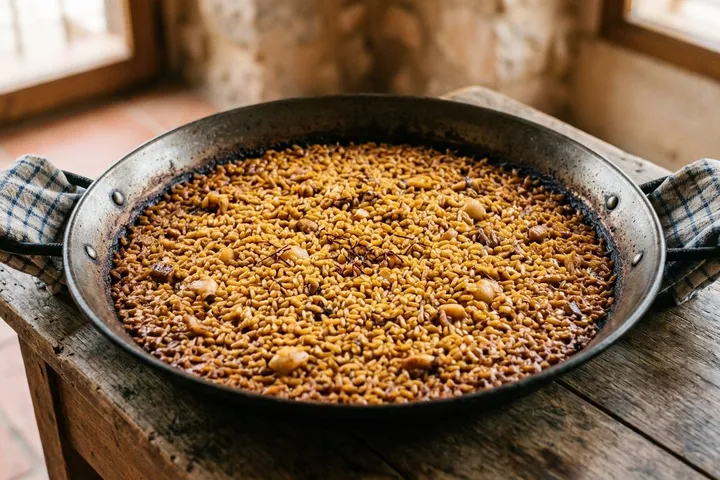
Arroz a banda for 4: ñora and baby cuttlefish sofrito, double the fish stock to rice, dry in the paella pan, fish served apart with potato and allioli.
Total time: 24 min
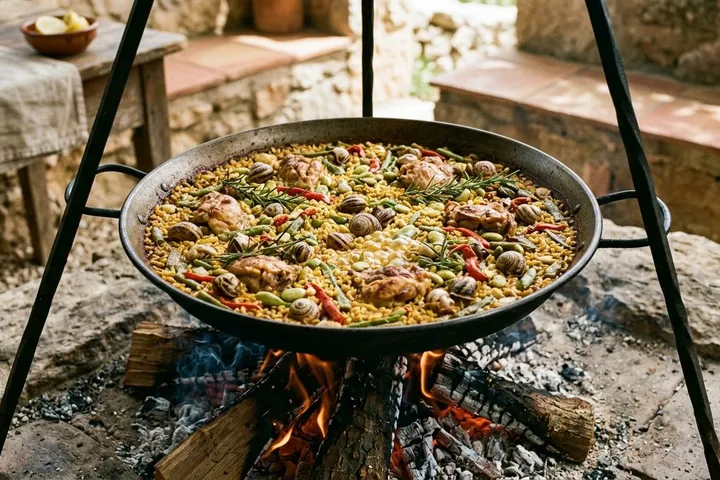
Rice with rabbit and snails
Rice with rabbit and snails is a countryside rice from inland Alicante: fried rabbit, purged snails and a fire of vine prunings, as in Monóvar.
Total time: 60 min
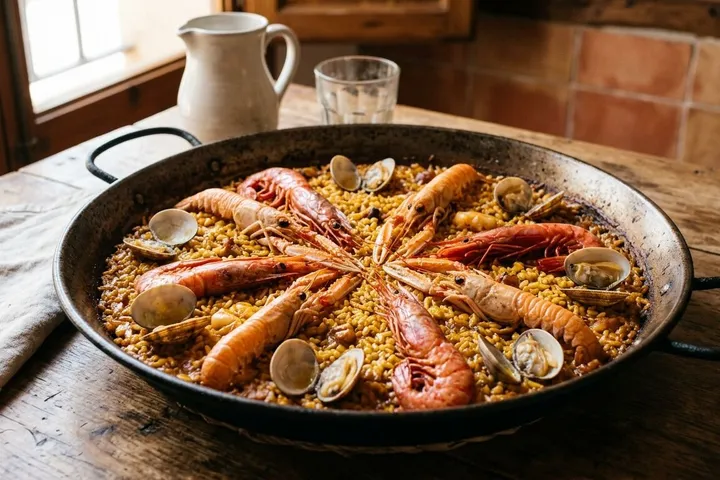
Seafood paella (paella marinera)
Seafood paella, or paella marinera, for 4: monkfish, tuna, prawns and clams with fumet, the cigalas laid on top at the end and a 5-minute rest.
Total time: 28 min
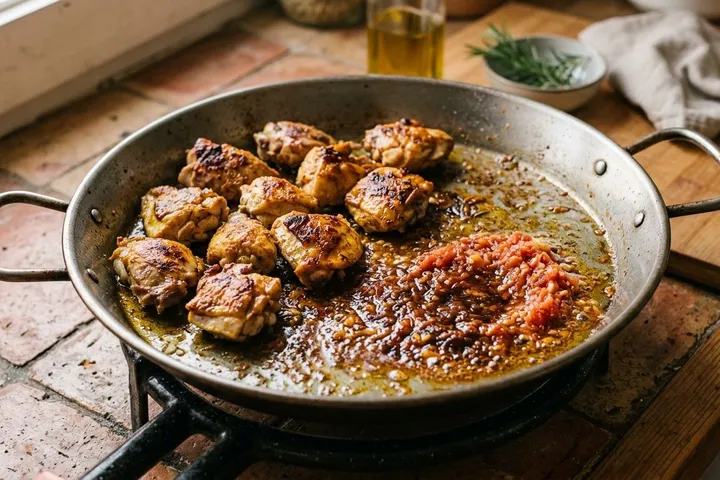
Sofrito for Valencian paella
The sofrito for Valencian paella is made in the paella pan itself: browned meat, tomato cooked slowly and the paprika last, taking care it doesn’t burn.
Total time: 8 min