The origin of paella lies in the Valencian countryside: the decree that declared it a Bien de Interés Cultural (a protected cultural asset) places it among the peasants and huertanos (the market gardeners of the irrigated plain) of L’Albufera de València, and the historians Frédéric Duhart and F. Xavier Medina date its birth to the early 19th century. Behind it lie a thousand years of rice on the peninsula, ever since the Andalusis (the Muslim inhabitants of al-Andalus) brought it. Here is the whole history of paella, separating what is documented from what is legend.
Before we start, the summary in six lines:
| What is documented | What is legend or can’t be proved |
|---|---|
| By the year 961 rice was already grown in al-Andalus | That Alexander the Great brought rice to Europe |
| The oldest recipe for “arroz a la valenciana” that can actually be read dates from 1760 | That paella has existed since Arab times |
| Valencian paella has been an intangible Bien de Interés Cultural since Decree 176/2021 | That a paella was filmed for the first time in 1896 |
Paella origin: where is it from?
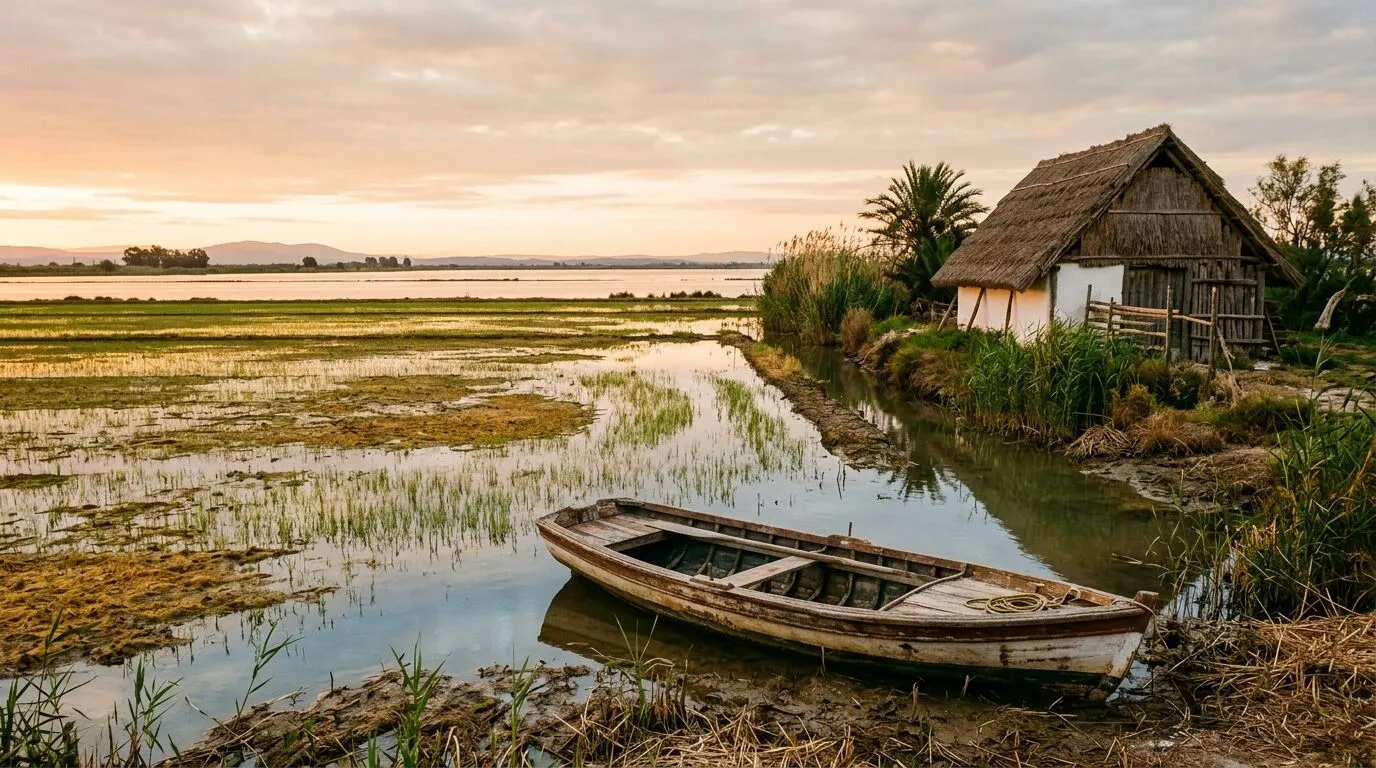
Paella is Valencian, and there is no argument about that. Decree 176/2021, approved by the Consell (the regional government) on 29 October 2021 and published in the BOE (Spain’s official gazette) on 15 March 2022, says so plainly: “los orígenes de la paella se encuentran a la Albufera de València, donde este plato se cocinaba con el fin de dar respuesta a la necesidad alimentaria de los campesinos y huertanos de la zona” (the origins of paella lie in L’Albufera de València, where the dish was cooked to feed the peasants and market gardeners of the area). The official name of what it protects is “la paella valenciana, el arte de unir y compartir” (Valencian paella, the art of bringing people together and sharing), and the file contains favourable reports from the universities of Jaume I, Alicante and València.
What the decree does not do is fix a recipe. To find out what goes in it and what doesn’t, see the glossary entry on Valencian paella, and to cook it, follow our Valencian paella recipe step by step.
Academic research narrows down the date. According to Duhart and Medina (2023), paella was born in the early 19th century, when the wheat crisis pushed the lower classes of the Valencian countryside towards rice. The farm labourers, who made migues (fried breadcrumbs, or migas) in a pan while they worked outdoors, swapped the bread for rice. So the short answer is this: paella comes from the market garden and the rice fields around València, and it is a good deal younger than people usually say.
Timeline: from Asian rice to today’s paella
| Date | What happened | Why it matters in the kitchen | Certainty |
|---|---|---|---|
| 9,000-10,000 years ago | Rice is domesticated in southern China | The cereal that will end up in the paella pan is born | Documented; the exact place is debated |
| 4th century BC | The Greeks learn of rice through Alexander’s expedition to India | Only as a curiosity and a medicine: nobody sows it around the Mediterranean | Documented |
| 8th-10th centuries | The Andalusis bring it; in 961 the Calendario de Córdoba (Calendar of Córdoba) already lists it as cultivated | It arrives with irrigation and canals | Probable in the 8th; documented in the 10th |
| 13th century | Al-Tuŷībī writes that it is grown almost only in Murcia and Valencia | Rice is already a Levante crop | Documented |
| 1342-1448 | Royal and municipal bans because of malaria | It keeps being planted, but is pushed out to the marshlands | Documented |
| 1753 | The Duke of Caylus, captain general under Ferdinand VI, marks out rice-growing reserves | The State decides where rice fields may exist | Documented |
| 1760 | Baretti copies a recipe for “arroz a la Valenciana” (published in 1770) | The oldest readable recipe under that name | Documented |
| Early 19th century | Paella is born among the common people of the Valencian countryside | Rice replaces breadcrumbs in the pan | Documented |
| 1889 | A traveller eats a paella with chicken, sausage, blood sausage and mussels in Sagunto | Mixed paella already exists | Documented |
| Late 19th century | Paella reaches the beach eateries of La Malvarrosa, the Grao de Castellón and the Albufereta | It becomes Sunday and restaurant food | Recorded in the BIC decree |
| 1913 | The Sueca Rice Station (Estación Arrocera de Sueca) is created | Valencian rice gets its own research centre | Documented |
| 1936 | Guardiola Ortiz describes the St James’s Day paella on San Juan beach in Alicante | Paella in the Alicante tradition | Recorded in the BIC decree |
| 1960s | Tourism turns paella into a national emblem | Paella leaves Valencia for good | Documented |
| 1986-2008 | Designations of origin arrive: Calasparra, Valencia and Ebro Delta | The grain is protected by its origin | Documented |
| 2018 | First World Paella Day | The dish gets its own day | Documented |
| 2021-2022 | BIC decree for Valencian paella | The custom is protected, not a recipe | Documented |
History of rice: from Asia to Europe
Where rice comes from
The rice we eat, Oryza sativa, was domesticated in southern China. A genetic study published in PNAS by Molina and his team (2011) places that origin between 8,200 and 13,500 years ago, in line with the sites that point to the Yangtze valley. Specialists still debate the exact spot, so the safe figure is this: some 9,000 or 10,000 years ago, in southern China.
When rice reached Europe
Long before it was grown, rice was known by hearsay. The Greeks learned of it in the 4th century BC from accounts of Alexander the Great’s expedition to India, and authors such as Horace or Dioscorides mention it as an exotic food or a remedy. According to Kokoszko and colleagues (2013), in Roman and Byzantine times the rice eaten around the Mediterranean was mainly imported from the East, and only the Arab conquests, from the 7th century on, managed to introduce its cultivation for good.
Here is the first stumble in the BIC decree. Its text states that the origins of rice in Europe “se remontan al año 330 a.C., con las incursiones índicas de Alejandro Magno, que trajo el arroz a Europa” (go back to 330 BC, with the Indian campaigns of Alexander the Great, who brought rice to Europe). The decree says so, but research doesn’t back it up: the Greeks knew of rice, they didn’t bring it to sow it. Nor is there any evidence that the Romans grew rice in Hispania.
Rice in al-Andalus
Rice reached the peninsula with the Andalusis. The article by Bueno Marí and Jiménez Peydró in the CSIC journal Hispania dates it “probablemente en el siglo VIII” (probably in the 8th century), in the same wave as cotton, saffron, citrus fruit and sugar cane. The written proof comes later: the Calendario de Córdoba (Calendar of Córdoba), from the year 961, already lists it as cultivated, as the historian Andrew M. Watson recalls. The most accurate thing to say is that it arrived between the 8th and 10th centuries and that by the 10th it is documented.
The Andalusi agronomists of the 11th and 12th centuries, such as Ibn Baṣṣāl or Ibn al-ʿAwwām, already write about growing it, and their texts look towards Córdoba and L’Albufera de València. In the 13th century, the Murcian author Ibn Razīn al-Tuŷībī summed it up in his recipe book, in the translation quoted by Parra Villaescusa: “Rice is scarcely grown in al-Andalus, except in my city, Murcia, or in Valencia, which are known for the cultivation and abundance of this cereal”. In other words, little across al-Andalus as a whole, and a lot in Murcia and Valencia. The historian Miriam Parra Villaescusa believes it was planted in market gardens, not over large areas.
What we have left of Andalusi cooking is, above all, words. According to the Royal Spanish Academy’s dictionary, arroz comes from Hispano-Arabic arráwz, which took it from the Greek óryza, which in turn took it from Tamil arici. Acequia (irrigation canal) and albufera, which in Arabic means “little sea”, also arrive through Arabic. In other words: the rice field speaks Arabic, even if paella came much later.
History of rice in Spain
Valencia and L’Albufera
The history of rice in Spain has its longest chapter around València, and it is a story of bans that nobody obeyed. The flooded rice field bred mosquitoes and with them came malaria. Already in the reign of Jaume I, according to Bueno Marí and Jiménez Peydró, the jurats (city magistrates) of València barred rice around the city “por razones de insalubridad” (on health grounds); there is no record that the king ordered it. At the Corts (parliament) of 1342, Pere the Ceremonious (Pere el Cerimoniós) ordered the rice fields eradicated in the town of Castelló, and Martí I extended the ban to the whole kingdom in 1403, according to Parra Villaescusa. Meanwhile, in 1386 an agreement was confirmed that brought the marshlands between the Guadalaviar and the Catarroja watercourse into cultivation, but without rice, and in 1448 the ban was repeated “bajo penas de muerte y confiscación de bienes” (on pain of death and confiscation of property).
None of this stopped the crop. According to Parra Villaescusa, rice very soon became one of Valencia’s great exports, even though it appeared among the coses vedades (forbidden things). In 1753, the Duke of Caylus, captain general of the kingdom under Ferdinand VI, marked out rice-growing reserves, and in 1790 came the ordinances of the Duke of Crillón, of “escasa eficacia” (little effect), according to the historian Salvador Calatayud. The key regulation of the 19th century was the Royal Order of 10 May 1860, which set the conditions for growing rice.
The Ebro Delta
Catalonia is today the second rice-growing region by area, and its rice with a name of its own comes from the Ebro Delta. The European Union registered the PDO (protected designation of origin) Arroz del Delta del Ebro on 27 October 2008, with Regulation (EC) 1059/2008.
Calasparra and Murcia
Murcia has a rice-growing tradition that goes back, as we have seen, to Andalusi times. Today its area is small, but its rice has a name of its own: the Ministry approved the regulations of the Calasparra DO (designation of origin) on 19 February 1986, as recorded in the BOE of 1991. It is the oldest of the three rice designations in this history.
The Guadalquivir and Extremadura
Andalusian rice is recent. There were earlier projects in the marshes of the Guadalquivir that came to nothing, and according to González Arteaga (1993) the crop was established “de una forma seria y planificada a partir de 1937” (in a serious, planned way from 1937 onwards). Valencian rice growers began arriving in the 1940s, and the great boom came in the 1960s. Today Andalusia is Spain’s leading rice-growing region. Extremadura completes the podium with almost 19,000 hectares in 2024.
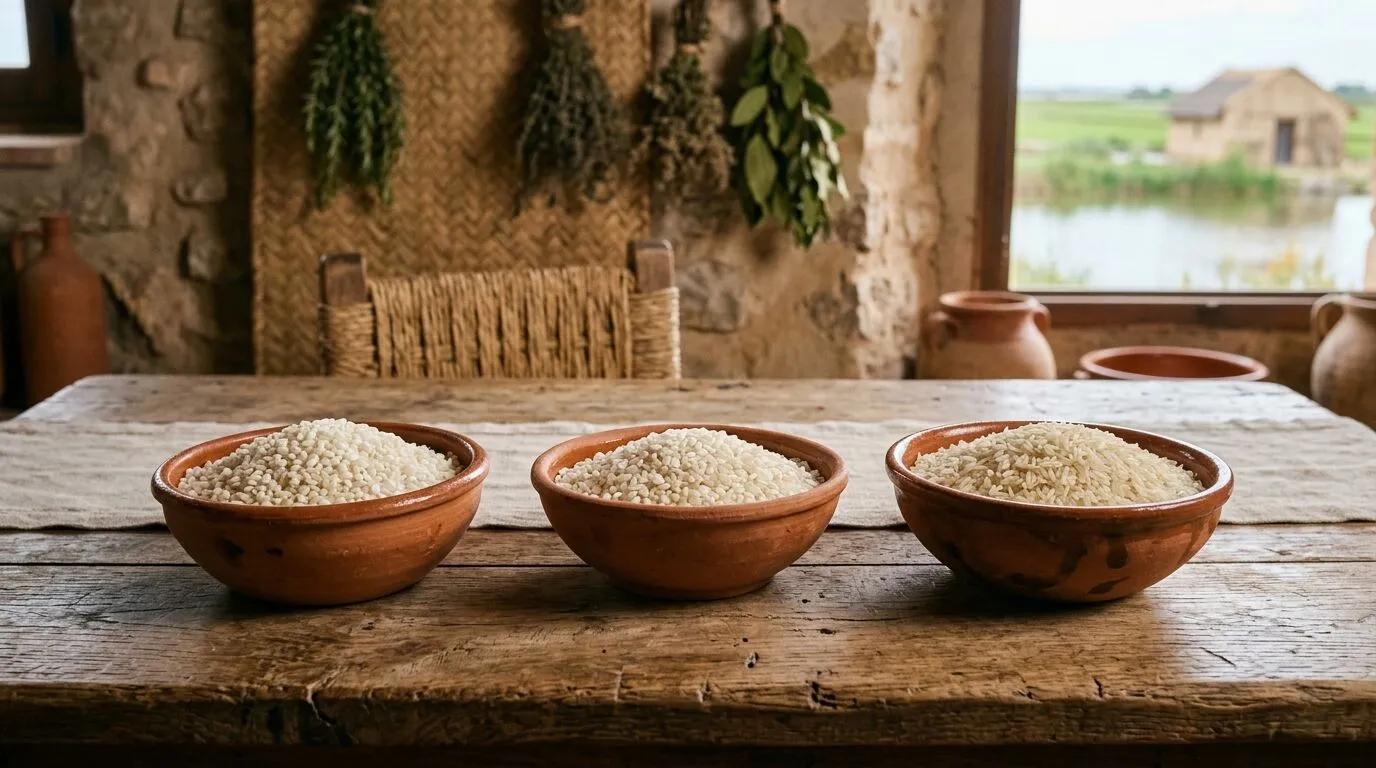
Rice-growing areas in a table
Areas for 2024, the latest year with final figures in the Ministry of Agriculture’s Anuario de Estadística (statistical yearbook). In total, Spain sowed 85,940 hectares and harvested 611,802 tonnes of paddy rice.
| Area | Historical milestone | Quality label | Area in 2024 |
|---|---|---|---|
| Andalusia (Guadalquivir marshes) | Planned cultivation since 1937 | — | 24,865 ha |
| Catalonia (Ebro Delta) | — | PDO Arroz del Delta del Ebro (EU, 2008) | 20,838 ha |
| Extremadura | — | — | 18,960 ha |
| Valencian Community (L’Albufera) | Andalusi agronomists of the 11th-12th centuries | PDO Arroz de Valencia (regulations of 2000, EU 2001) | 15,373 ha |
| Murcia (Calasparra) | Mentioned by al-Tuŷībī in the 13th century | DO Calasparra (1986) | 442 ha |
The Valencian Community accounts for 17.9% of the area and is Spain’s fourth rice-growing region. In dry years the split changes a lot: with the drought of 2022 and 2023, the national area fell to around 55,000 hectares, Andalusia dropped to 1,823 in 2023 and Valencian rice, which held steady, came to be almost 28% of the total.
Rice in the Valencian Community: L’Albufera, Sueca and southern Alicante
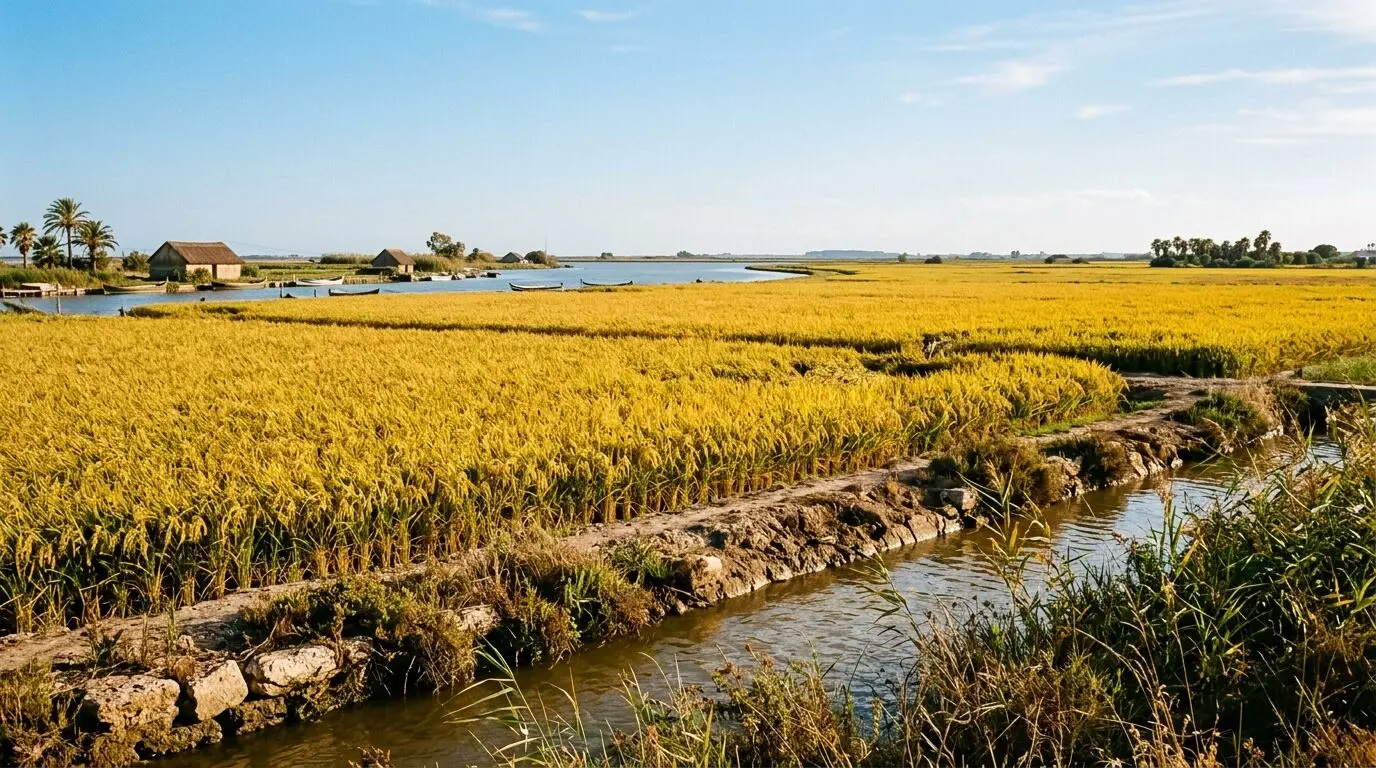
Rice growing in the Valencian Community is almost entirely a matter for the province of Valencia: in 2024 it totalled 14,791 hectares, against 430 in Alicante and 152 in Castellón. The centre is still L’Albufera, today a natural park. According to the PDO specification, the park covers 21,120 hectares, with rice fields on 65% of its surface.
The PDO Arroz de Valencia is young. The Conselleria (the regional ministry) approved its regulations on 21 September 2000, the Ministry of Agriculture ratified them in 2001 and that same year the European Union registered it as a protected designation of origin, with Regulation (EC) 1971/2001. The 2024 specification covers Senia, Bahía, Bomba (with its analogue Bombón), J. Sendra, Montsianell, Gleva, Sarçet and Albufera, and since that year also Campanar PV, Regina and Hispasur. Of them all, the one most sought after outside Valencia is bomba rice, which has its own entry. And if you wonder why some rice dishes come out dry and others with broth, look at the difference between dry, creamy and soupy rice.
Sueca deserves a line of its own. In 1911 a rice disease, the fallada, caused a crisis in the countryside, and on 7 February 1913 the Sueca Rice Station was created at the request of the farmers themselves, according to López-Campos (1970). Sueca also hosts the Concurso de Paella (paella competition), which the BIC decree dates to 1961.
Southern Alicante
From Aspe, in the Vinalopó, rice is another story. The province of Alicante has barely any rice fields today, but it once did. Parra Villaescusa documents that in the Orihuela of the late Middle Ages rice was planted in secret in the market garden: in 1433 the town council punished clandestine rice fields with a fine of 2,000 florins and in 1458 it repeated the ban. It is the best written evidence there is of rice in southern Alicante.
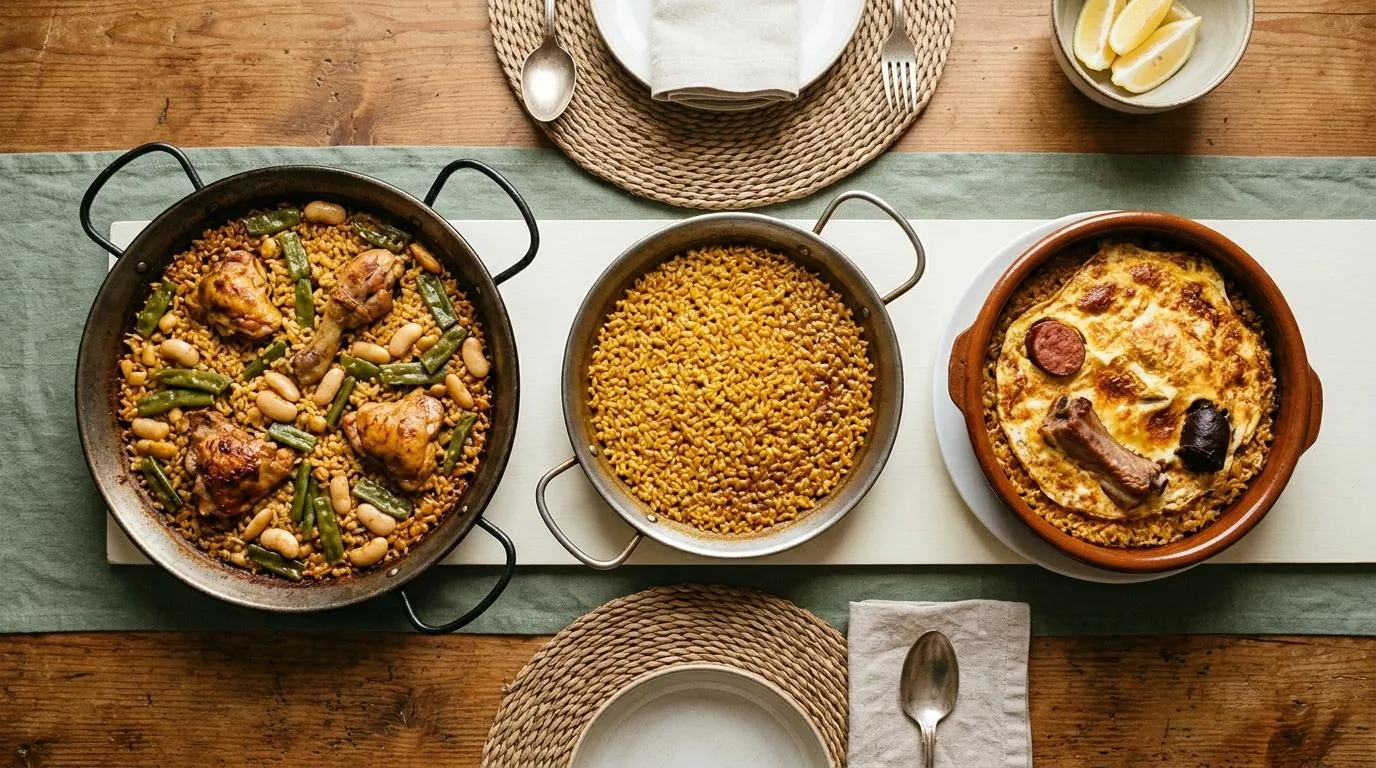
What has survived is a rice cuisine with a character of its own. Arroz con costra, with its layer of set egg, is the dish of Elche and the Vega Baja; its origin isn’t written in any old document, it is living tradition, and the best way to get to know it is our arroz con costra recipe. On the coast, seafood rice dishes rule: arroz a banda, which you can make with the arroz a banda recipe, and arroz del senyoret. And from the interior, rice with rabbit and snails cooked over a wood fire, as it is eaten in the Vinalopó.
Where the word “paella” comes from
The word comes from the pan, not from the dish. The Royal Spanish Academy’s dictionary explains it like this: “Del valenciano paella, este del fr. ant. paele, hoy poêle ‘sartén’, y este del lat. patella ‘pequeño plato en que se cocinaba’” (from Valencian paella, from Old French paele, today poêle, ‘frying pan’, and from Latin patella, ‘a small dish in which food was cooked’). In Valencian, as in the rest of Catalan, paella is the frying pan; over time, the flat, two-handled pan in which the rice was cooked ended up giving its name to the dish.
That is why in València people say “la paella” both for the dish and for the pan, while outside the Valencian Community the word paellera is used more. You will find the details of names and sizes in the entry on the paella pan. That wide, shallow pan also explains the technique: a thin layer of rice, plenty of surface over the fire and, if the cook gets it right, the socarrat (the toasted crust) stuck to the bottom.
From arroz a la valenciana to paella: how it evolved
The precursors
In the great medieval recipe books of the Crown of Aragon rice hardly appears. The BIC decree acknowledges that it is barely mentioned in the 14th-century Llibre de Sent Soví (Book of Sent Soví) or in Rupert de Nola’s book. The latter, the Llibre del coch (Book of Cookery), was printed in Barcelona in 1520, according to the Biblioteca de Catalunya. Neither contains anything like a paella. If you want the context of that medieval cooking, it is in the history of Valencian cuisine.
The oldest recipe that can actually be read comes in the 18th century and is signed by an Italian traveller. In a letter dated Madrid, 8 October, which the neighbouring letters place in 1760 and which was published in 1770, Giuseppe Baretti copies a recipe for making “arroz a la Valenciana; that is, rice after the manner of Valencia”: pigs’ feet, mutton trotters, bacon, new sausages, blood puddings, saffron and a few egg yolks. It looks little like today’s paella. The first mention, on the other hand, is attributed to an earlier 18th-century manuscript whose text is not accessible.
That is the recipe manuscript the BIC decree speaks of: according to the decree, it already asked for the rice to be dry, but the decree doesn’t say which one it is or give it a date. The decree also cites Francisco de Paula Martí, who agreed with the Valencians that “nadie ha llegado a saberle condimentar mejor que ellos” (nobody has ever learned to cook it better than they do) and criticised the half-cooked rice served “llamándolo equivocadamente arroz a la valenciana” (wrongly calling it arroz a la valenciana). The decree dates that text to 1513, but that is the year of the first edition of Gabriel Alonso de Herrera’s Agricultura general (General Agriculture), not the year of Martí’s text. The work was reissued in Madrid in 1818-1819 with additions by the Real Sociedad Económica Matritense (Madrid Royal Economic Society), as recorded by the Biblioteca Virtual del Patrimonio Bibliográfico, and it is to that reissue that Martí’s text is attributed. We haven’t been able to see the page, so we give no exact year. What it does make clear is that, by the time it was written, the fame of Valencian rice was already a commonplace.
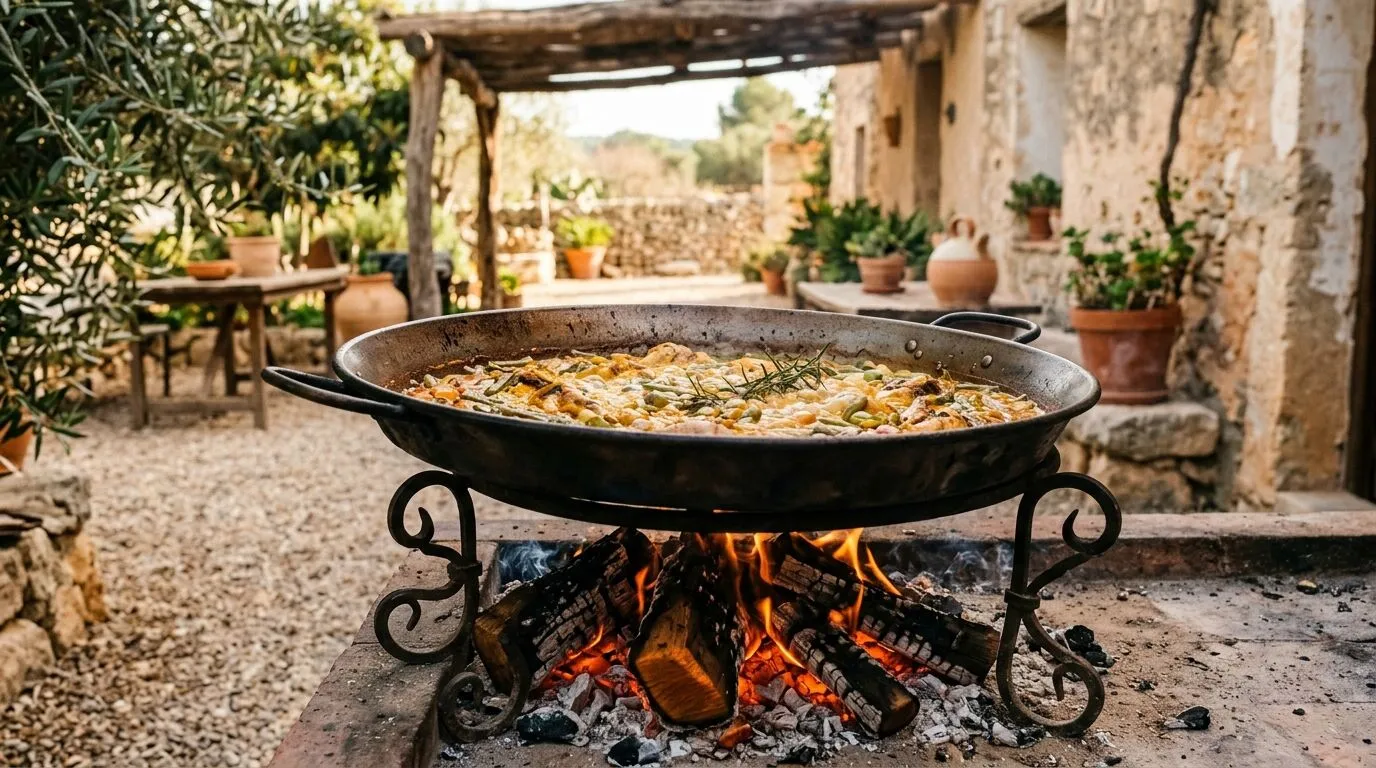
The first paella
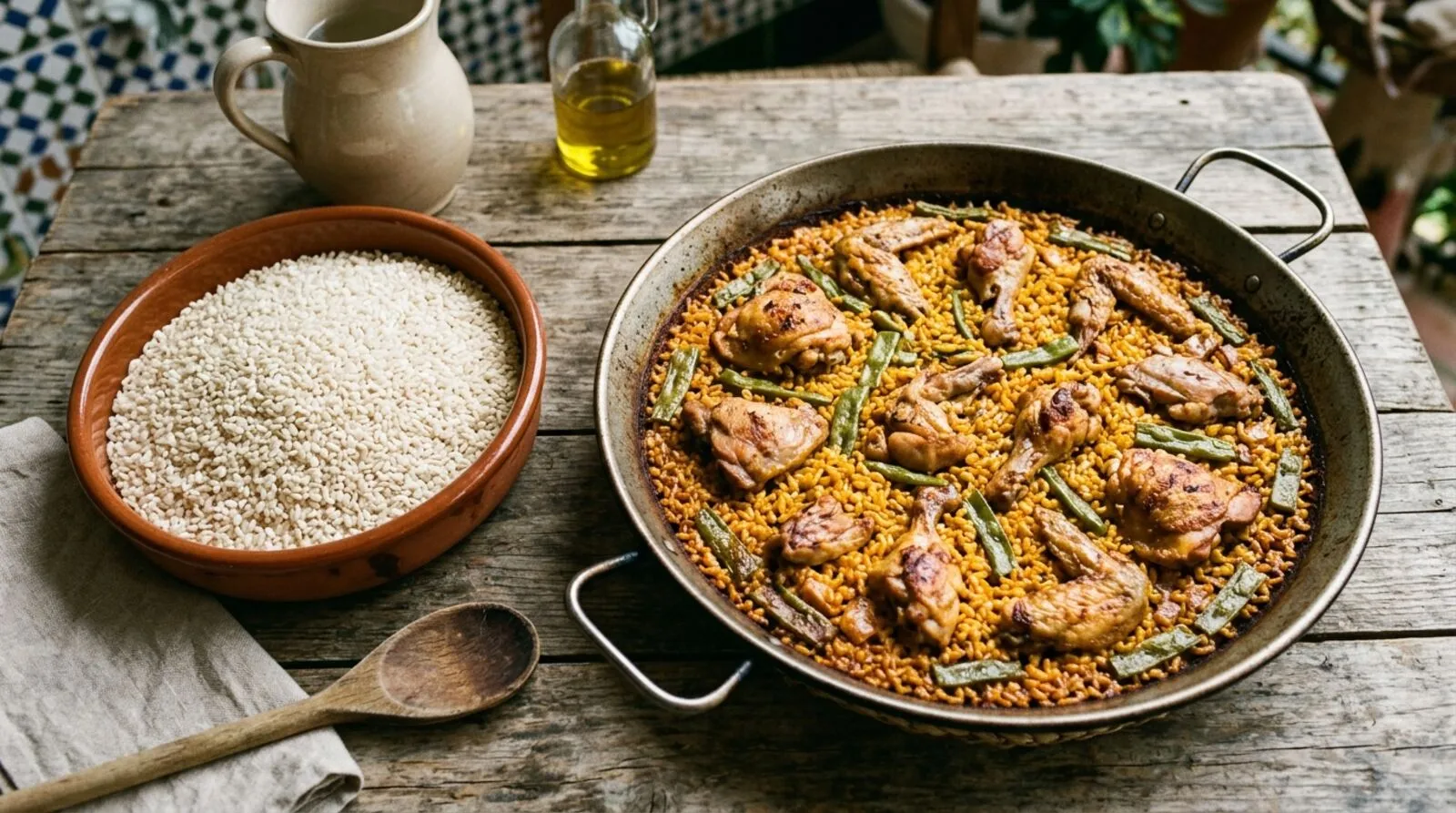
Paella as such was born in the early 19th century, according to Duhart and Medina. Not in palaces, but in the countryside: wheat was scarce, rice was to hand and the men cooked it outdoors in a big pan. It was a working dish, and over time the ingredients that now distinguish Valencian paella were fixed, such as garrofó (the large flat butter bean).
The 19th century
Around 1850 the Valencian elite adopted the dish and took distinguished guests to eat paella on the shore of L’Albufera. In 1868 the French chef Urbain Dubois published a “Paëlla à l’espagnole” in his cookbook of world cuisines. In 1889 a traveller, Alfred Crouzat, ate a paella at the Parador de San Joaquín in Sagunto with chicken, sausage, blood sausage, mussels, clams and tomatoes: a mixed paella through and through, more than a century before today’s arguments. If you like the seafood side, you will find the seafood paella in the recipe collection.
At the end of the century, according to the decree, paella jumps from the barracas (thatched farmhouses) and alquerías (farmsteads) to the beach eateries of La Malvarrosa, the Grao de Castellón and the Albufereta in Alicante.
Expansion and tourism
In 1905 a Madrid restaurant was already advertising “paella con pollo y mariscos” (paella with chicken and seafood), and in 1929 the restaurant Barcelona in Paris offered “Paella Valenciana”. In Alicante, José Guardiola Ortiz describes in his Gastronomía alicantina (Alicante Gastronomy, 1936) the rice with rabbit and the paella eaten on St James’s Day on San Juan beach.
The great leap comes with tourism. The decree says paella “alcanza su zenit con el boom turístico de los años 60” (reaches its zenith with the tourist boom of the 1960s), and Duhart and Medina speak of a genuine “hyper identification” of Valencia with paella. In the 1960s and 1970s home-made paella reached kitchens in the Basque Country and Galicia, and abroad it became an emblem of Spain.
Today: Bien de Interés Cultural
The last chapter is official recognition: Decree 176/2021 declares Valencian paella an intangible Bien de Interés Cultural. It is not a UNESCO declaration but one by the Consell, and what it protects, as its own name says, is “the art of bringing people together and sharing”: it fixes no ingredients.
Who invented paella: versions and legends
Nobody invented paella: it is peasant cooking that changed with every generation. Plenty of stories circulate about its origin, some of them in official texts. This is how they stand against the documents:
| Version | What it says | What can be checked |
|---|---|---|
| Alexander the Great | He brought rice to Europe in 330 BC (says the BIC decree) | The Greeks knew of it, but it wasn’t grown around the Mediterranean until the Arabs |
| Arab origin of the dish | Paella has existed since al-Andalus | The Andalusis brought rice; paella dates from the 19th century |
| Jaume I | On conquering València he limited rice to L’Albufera (says the decree) | The city’s jurats issued a ban during his reign, with no year; there is no record that the king ordered it |
| Martí in 1513 | A treatise of 1513 already speaks of “arroz a la valenciana” (says the decree) | 1513 is the first edition of Herrera; Martí’s text is attributed to the 1818-1819 reissue |
| The 1896 film | A paella was filmed for the first time that year (says the decree) | It has not been found in film catalogues |
| Roosevelt and chicken with rice | Delmonico’s in New York, a place “very often frequented” by Franklin D. Roosevelt, served chicken with rice (says the decree) | We have found no source other than the decree |
| Peasants of L’Albufera | Paella is born as food for market gardeners and peasants | Yes: the decree says so and Duhart and Medina confirm it, dating it to the early 19th century |
From the countryside to the party: paella today
Paella was born to feed a lot of people, and it is still the dish of big gatherings: patron saint fiestas, comparsa meals (the feasts of a Moors and Christians troop), birthdays in the country. Every 20 September there is also World Paella Day, which began in 2018.
When the group grows, the questions stop being historical and become practical. For working out the shopping, there is our guide to how much rice per person, and for putting together a big meal, the one on paella for 100 people. If what you want is paella as the centrepiece of the town fiesta, take a look at the giant paella and our service for local fiestas.
Where to go next
- Cook: black rice, fideuà from Gandia and the rest of the rice dishes in our recipe collection, with Valencian paella at the head.
- Understand: the glossary of cooking and events, with entries on Valencian paella, the paella pan, bomba rice or socarrat.
- Order it: our live paellas and rice dishes for groups, paella delivery and catering in Aspe and the Vinalopó, Alicante and Valencia.
If you have a date in mind, tell us how many of you there are and where in the quote form.
Sources
- Decree 176/2021 of 29 October of the Consell, declaring Valencian paella, “the art of bringing people together and sharing”, an intangible Bien de Interés Cultural (BOE-A-2022-4133)
- Duhart and Medina (2023), Notes on Rice in Western European Food Cultures in General and Paella in Particular
- Giuseppe Baretti, A Journey from London to Genoa, vol. II (1770): recipe for “arroz a la Valenciana”
- Molina et al. (2011), Molecular evidence for a single evolutionary origin of domesticated rice, PNAS
- Kokoszko, Jagusiak and Rzeźnicka (2013), Rice as a Foodstuff in Ancient and Byzantine Materia Medica, Studia Ceranea 3
- Andrew M. Watson, The Islamic conquest and the new crops of al-Andalus (Spanish edition, Ministry of Agriculture library)
- Bueno Marí and Jiménez Peydró (2010), Crónicas de arroz, mosquitos y paludismo en España (Chronicles of rice, mosquitoes and malaria in Spain), Hispania (CSIC)
- Parra Villaescusa (2013), El cultivo del arroz en Orihuela a finales de la Edad Media (Rice growing in Orihuela in the late Middle Ages), Medievalismo 23
- Calatayud (2012), El Estado en los campos (The State in the fields), Investigaciones de Historia Económica
- López-Campos (1970), Pequeña historia y labor actual de la Estación Arrocera de Sueca (A short history and current work of the Sueca Rice Station) (ReDIVIA, IVIA)
- González Arteaga (1993), Valencianos y arroz en las marismas del Guadalquivir (Valencians and rice in the Guadalquivir marshes), Revista de Estudios Andaluces
- Diccionario de la lengua española (Royal Spanish Academy): paella
- Biblioteca de Catalunya: the Llibre del Coc by Mestre Robert (Barcelona, 1520)
- Biblioteca Virtual del Patrimonio Bibliográfico: Agricultura general by Gabriel Alonso de Herrera, with additions by the Real Sociedad Económica Matritense (Madrid, Imprenta Real, 1818-1819)
- Regulations of the Denominación de Origen Arroz de Valencia (BOE, 13 July 2001)
- Regulation (EC) 1971/2001: registration of the PDO Arroz de Valencia
- Product specification of the PDO Arroz de Valencia (Ministry of Agriculture, 2024)
- Regulations of the Denominación de Origen Calasparra (BOE, 7 May 1991)
- Regulation (EC) 1059/2008: registration of the PDO Arroz del Delta del Ebro
- Ministry of Agriculture, Anuario de Estadística: rice area and production by autonomous community (final 2024 data)
- Ministry of Agriculture, Anuario de Estadística 2024: paddy rice, detailed provincial analysis for 2023 (table 7.1.22.1)
- Decree 176/2021 in the DOGV no. 9211, 9 November 2021
- Celebrate World Paella Day on 20 September, Turespaña press release (2018)