
The history of Valencian cuisine begins long before paella: with the wine of the Iberians of Dénia, the Roman salted fish of Santa Pola and, above all, with the irrigation and the rice that came with al-Andalus. Layer after layer was added on top of that base: the sugar of Gandia, the medieval recipe books, the tomato and the pepper from the Americas, the orange of the 19th century and, finally, the beach-eatery paella that everyone knows today.
We tell it here from a kitchen in Aspe, so we also look towards Alicante, the Vinalopó and the Vega Baja, which in the guidebooks tend to end up as a footnote. Further down you’ll find the full timeline in a table.
A cuisine of market garden, sea and dry country
Valencian cooking comes from three landscapes a few kilometres apart: the irrigated market garden with L’Albufera next door, the sea, and the dry farmland of the interior. Almost all its dishes are born from one of the three, or from mixing them.
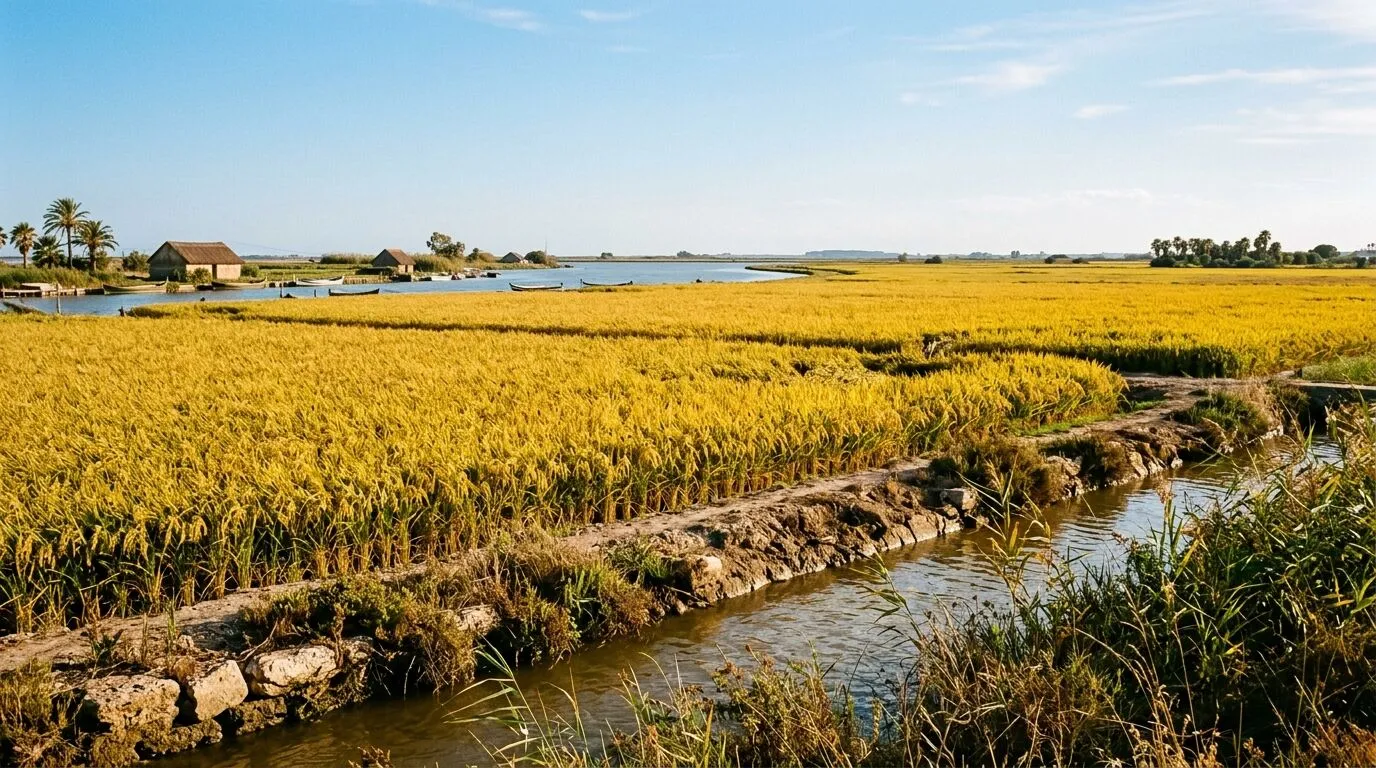
Market garden and L’Albufera
L’Horta de València is a mosaic of small plots watered by irrigation canals (acequias). In 2019 the FAO designated it a Globally Important Agricultural Heritage System and dates the origin of that irrigation to the 8th century; today it still waters some 120 km². For centuries the water has been shared out under its own rules: the Water Tribunal (Tribunal de las Aguas) meets every Thursday that isn’t a public holiday, at noon, at the Gothic door of the cathedral, with representatives of eight canals of the Turia.
This market garden gives us the vegetables that define the cooking here, like the garrofó, the large flat butter bean of paella, and next to it lies L’Albufera, where rice found its home. Without the market garden and the marsh there would be no paella.
Sea
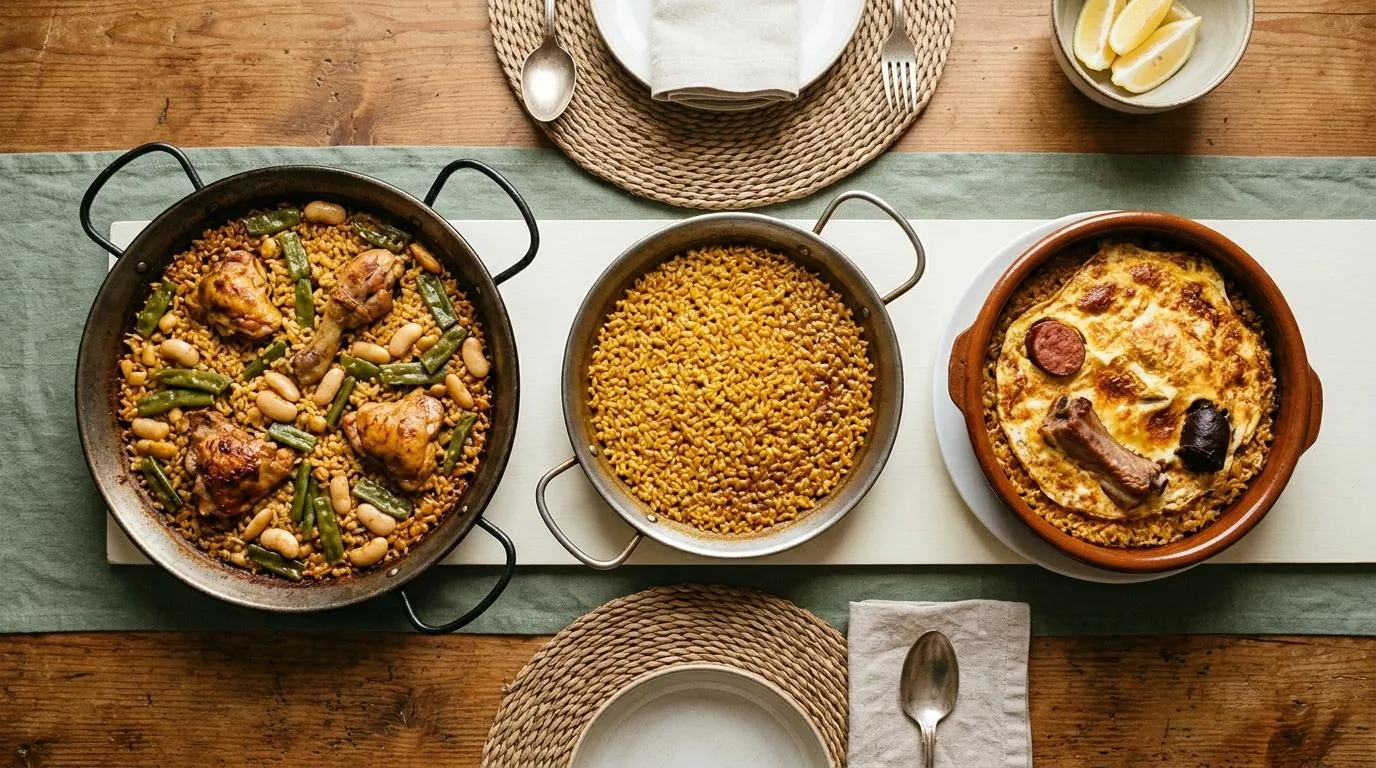
On the coast, preserving fish goes back a very long way. At the Portus Ilicitanus, in Santa Pola, the Museo del Mar uncovered a Roman fish-salting factory in 1987, in use from the 1st and 2nd centuries until the late Roman Empire. The sea also gives us the rice dishes made with fish stock: arroz a banda, with the fish served separately, arroz del senyoret, where everything comes peeled or fideuà, which swaps the rice for noodles. From the Albufera comes the eel all i pebre, a stew of garlic, sweet paprika and potato, with no rice.
Inland and mountains
Inland it is dry farming that rules, and the vine is one of the oldest crops of this land. At the Alt de Benimaquia, near Dénia, an Iberian settlement with four rooms holding wine presses and thousands of grape pips left the oldest documented wine production in the western Mediterranean, between the end of the 7th and the middle of the 6th century BC. That thread of wine is still alive in the Vinalopó, with the monastrell and the fondillón of the DOP Alicante. In the mountains, wheat and almonds shape the cooking: in Xixona the almond tree replaced cereal in the mid-18th century, and that almond is the base of its turrón.
Timeline of Valencian cuisine, century by century
| Period | What happened | Why it matters in the kitchen | Where you can still see it |
|---|---|---|---|
| Late 7th – mid 6th century BC | Iberian wine presses at the Alt de Benimaquia (Dénia) | The vine and wine reach the table very early | DOP Alicante, Valencia and Utiel-Requena |
| 1st–2nd century AD to the late Roman Empire | Roman fish-salting factory at the Portus Ilicitanus (Santa Pola) | Salt as a way of keeping fish | Portus Ilicitanus (Salinas-Picola), Santa Pola |
| 8th–10th centuries, al-Andalus | Irrigation canals in l’Horta (8th century, according to the FAO) and the arrival of rice (between the 8th and 10th centuries; documented in the 10th) | The irrigated market garden is born, and the cereal that will end up in paella | L’Horta de València, L’Albufera |
| 1238 | Jaume I enters València on 9 October and keeps the irrigation system (privileges of 1239 and 1251) | The Moorish market garden keeps working under the new kingdom | 9 d’Octubre, the Water Tribunal |
| 1342–1458 | Rice bans: Pere the Ceremonious, Joan I, Martí I and the council of Orihuela | Rice is kept under watch because of malaria, but it is still grown and exported | L’Albufera rice fields |
| Around 1324 or mid-14th century | Llibre de Sent Soví (“Book of Sent Soví”), a medieval Catalan recipe book | The cooking of noble tables is put in writing | Manuscript of the Universitat de València |
| 1395–1581 | Sugar mills (trapigs) in Oliva and Gandia; peak of 36,000 sugar loaves in 1581–1582 | Sugar enters sweets | Turrón and festive sweets |
| 1520 | The Llibre del coc (“Book of the Cook”) of Mestre Robert is printed in Barcelona | First printed recipe book in Catalan | 1520 copy in the Biblioteca de Catalunya |
| 16th–18th centuries | Peppers, beans, sweet potato and, later, tomato arrive | The sofrito, the vegetables and the sweets change | Paella sofrito, garrofó, sweet potato pastissets |
| 18th century | First mention of paella, or “arroz a la valenciana”, in a manuscript (according to the BIC decree); Cavanilles travels the kingdom | Dry rice already has a name of its own | Valencian paella |
| 19th century | Oranges are shipped to France (1848) and England (1863); by the end of the century paella reaches the beach eateries | An export market garden; paella leaves the home | La Malvarrosa, the Grao de Castellón, the Albufereta |
| Around 1920 | Bagging of table grapes begins in Novelda | The Vinalopó’s own product | Aspe, Novelda and their comarca |
| 1996–2016 | European registration of PDOs and PGIs: turrón, bagged grapes, tiger nut, rice, citrus, pomegranate… | Named produce is protected | The 23 quality schemes of the Comunitat |
| 2021–2022 | Decree 176/2021: Valencian paella, an intangible Bien de Interés Cultural (BOE, 15 March 2022) | The custom of cooking it and sharing it is protected | Any fiesta paella |
The Moorish legacy on the plate
If one moment changed Valencian cooking for good, it was al-Andalus. What it left wasn’t one particular dish: it was organised water and a batch of new crops.
Rice and irrigation
CSIC researcher Expiración García Sánchez puts it this way: rice was introduced into al-Andalus “very early, in the 10th century”, and in the Levante its production reached “a relatively high level”. At the start of the 13th century, she adds, rice in this area was used to make bread and thick soups.
Irrigation also has Andalusi roots, though with nuances. The Universitat de València says that the origin of the Water Tribunal “is not definitively established” (“no està definitivament establert”) and that the evidence points to Muslim times; attributing it to Abd al-Rahman III or Al-Hakam II was done without proof, and the idea of a Roman tribunal was ruled out by the jurist Borrull in 1831.
To know how people ate then, you have to look a little further south. Ibn Razīn al-Tujībī (1227–1293) was from Murcia, fled to North Africa and wrote his recipe book, the Fiḍālat al-khiwān, probably in Tunis, with 475 recipes in the only complete manuscript, held by the British Library. Manuela Marín translated it into Spanish in 2007 as Relieves de las mesas (“Leftovers from the tables”). It isn’t a Valencian book, but it is one of the best accounts of how people ate in the Andalusi Levante.
Vegetables, citrus and tiger nuts
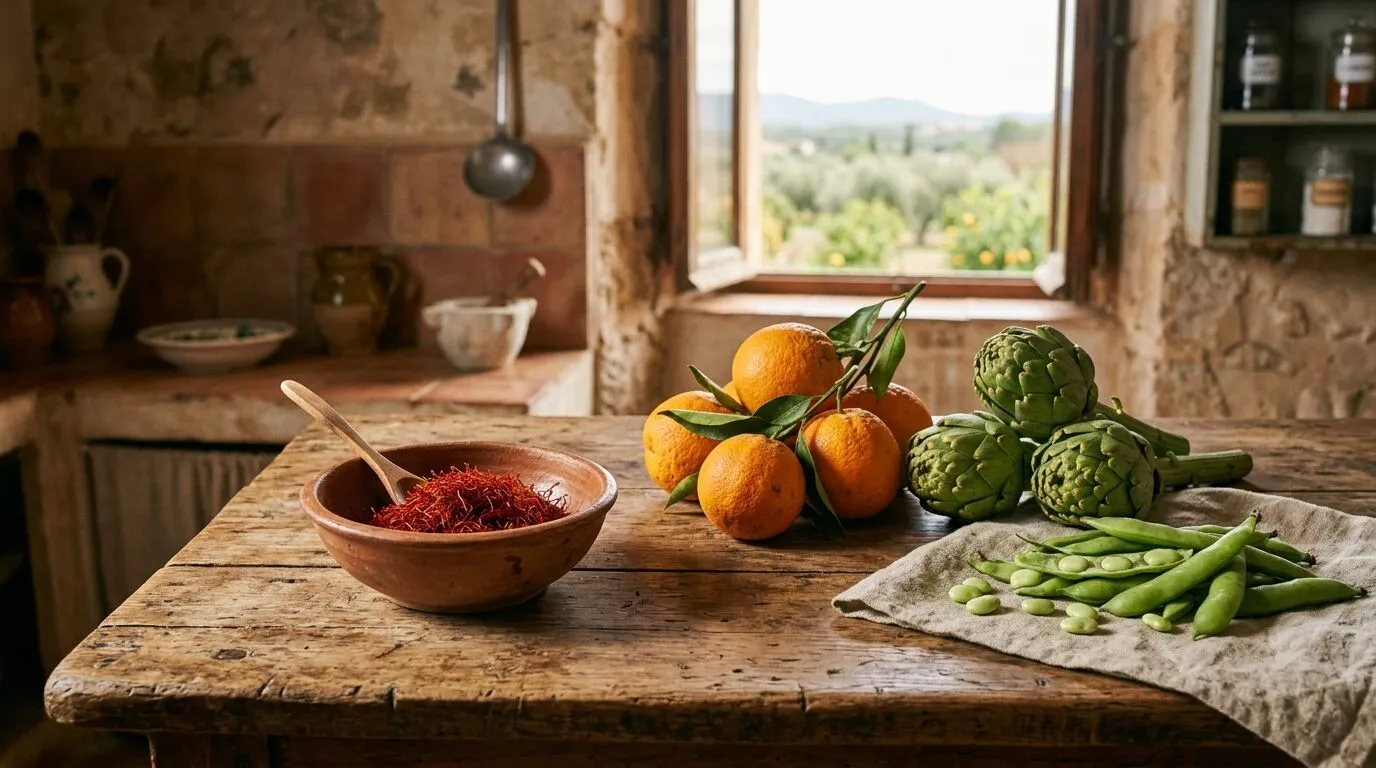
Al-Andalus brought vegetables that today we think of as having always been ours. García Sánchez names the aubergine and spinach among the most characteristic of the Islamic world. Citrus fruits settled in gradually: the bitter orange, the lemon and the lime were valued above all as medicine. The sweet export orange, the one that made the Ribera famous, came much later: its first orchards date from the late 18th century, and exports began in 1848.
Something similar happens with sugar. Cane arrived in Andalusi times, but it was grown on the coasts of Málaga and Granada, and in everyday cooking honey remained king. In Valencian lands sugar is first documented under the Christian kings, as you will see below.
Tiger nut, the one behind horchata, has an official history in the specification of its designation of origin, which says the Arabs introduced it and that in the 13th century its cultivation spread across what is now the Comunitat. The tale of Jaume I tasting the drink and saying “això és or, xata” (“this is gold, my dear”) is a charming legend with no document behind it.
The Kingdom of València: canals, watched rice and cookery books
València surrendered to Jaume I in late September 1238 (on the 22nd, according to the Enciclopèdia Catalana; sources disagree on the day), and the king entered the city on 9 October, the date celebrated today on 9 d’Octubre, Valencian Community Day. For the kitchen, what counts is what didn’t change: the new king legislated so the canals would keep running, with a privilege to the Reial Séquia de Montcada in 1239 and another on the canal wardens of València in 1251.
Rice, a crop under suspicion
At the start of the 14th century rice was well established in Valencia and Castellón, and that worried people: flooded rice fields were linked to fevers. According to the study by Miriam Parra Villaescusa, of the Universidad de Alicante, at the Corts (parliament) of 1342 Pere the Ceremonious ordered it eradicated in the town of Castelló and repeated the order in 1375; Joan I confirmed the ban in La Plana in 1388, and Martí I extended it to the whole kingdom in 1403. In the south, the council of Orihuela imposed fines of 2,000 florins for clandestine rice fields in 1433 and banned them again in 1458.
Even so, rice very soon became one of the great Valencian exports. The rice-growing area of the market garden lay south of the city, next to L’Albufera, near Silla and Alcàsser. You often read that it was Jaume I who limited rice fields to L’Albufera, and even the paella decree says so. There is no record that the king ordered it: during his reign, according to Bueno Marí and Jiménez Peydró (CSIC), it was the city’s jurats (magistrates) who banned rice around València on health grounds, and the documented royal bans come from his successors.
The first cookery books
The Llibre de Sent Soví (“Book of Sent Soví”) is the great medieval recipe book in Catalan. The oldest manuscript we have is in the Biblioteca Històrica of the Universitat de València: an early 15th-century copy with 72 recipes. The Universitat dates the lost original to around 1324 and celebrated its 700th anniversary with an exhibition in 2025; the Biblioteca de Catalunya prefers to place it in the mid-14th century. It is the cooking of noble tables, and, given its date, it contains not a single American ingredient.
Shortly afterwards, Francesc Eiximenis, settled in València since 1382, wrote a good part of his Terç del Crestià (“Third Book of the Christian”) there. It isn’t a recipe book but a moral treatise. Its chapter on the table praises how the catalans eat, and the researcher Xavier Renedo, of the Universitat de Girona, believes he wrote it with readers in Barcelona or Girona in mind, so it shouldn’t be sold as praise of Valencian cooking.
In 1520, Carles Amorós printed in Barcelona the Llibre del coc (also spelt Llibre del coch; “Book of the Cook”) by Mestre Robert, whom many know as Rupert or Ruperto de Nola, cook to King Ferran I of Naples. The Spanish translation appeared in 1525. For its author, the three flowers of all the cuisines of the world were the “salsa de pago”, the “mig-raust” and the “menjar blanch”. It is sometimes said that the first arroz con costra is in there, but nobody has shown it with the text in hand.
The sugar of Gandia
Valencian sugar has a paper trail going back to the late 14th century. The first trapig, the cane mill, is documented in Oliva in 1395, and in 1434 another is mentioned in the Real de Gandia. The dukes of Gandia controlled plantations and mills: in 1545 they had seven trapigs and in 1581–1582 they reached their peak, 36,000 sugar loaves. After the expulsion of the Moriscos, decreed in 1609, production collapsed from 1610, pushed down further by cheaper American and Canary Island sugar.
From that period also comes the first document on turrón cited in its official specification: in 1484 the Consell de València ordered fifteen pounds of “torrons d’alegria” and fifteen of “torrons blancs”.
What came from the Americas
American produce didn’t arrive all at once. The historian M.ª Ángeles Pérez Samper explains that peppers, beans, chocolate, sweet potato and turkey were taken up quickly, that the tomato didn’t catch on until the 18th century, and that the potato and maize took longer still to become everyone’s food.
According to the historian Montserrat Durán, in Valencian lands some American plants adapted so well that already in the 17th century they changed the rural economy, long before they did in Catalonia. Of the tomato, on the other hand, few papers survive: in 1758 Altamiras’s recipe book already teaches how to preserve it, and the traveller Joseph Townsend noted in 1786–1787 that tomatoes were being grown around València.
That is where some of today’s seemingly timeless staples come from. The grated tomato in the paella sofrito. The garrofó, which is an American bean (Phaseolus lunatus) even though nobody has yet dated its arrival. And the sweet potato, the moniato, which fills the Christmas sweet potato pastissets.
18th and 19th centuries: Cavanilles and the orange
The great witness of the Enlightenment Valencian countryside is the botanist Antonio José Cavanilles. His Observaciones sobre el Reyno de Valencia (“Observations on the Kingdom of Valencia”) were published between 1795 and 1797, and he also wrote on rice growing (1797), on orange growing in the Orihuela market garden (1799) and on tiger nuts (1800).
The orange revolution begins in the late 18th century in Carcaixent, where the Enciclopèdia Catalana credits the parish priest Vicent Montsó with the first orange groves. Oranges were shipped to France in 1848 and to England in 1863. According to Adrià Besó’s study, they spread from two centres, the Ribera and La Plana, and enjoyed their great expansion in the 19th century with better transport and with the motor pumps that raised water from 1880. The first plantations in l’Horta Nord and l’Horta Sud date from 1870, and the landscape of the market garden changed with them.
Meanwhile, the water stayed in the hands of the same people as ever: the 1879 Water Act (Ley de Aguas) recognised the existence and privileges of the Water Tribunal.
Rice and paella: the short story
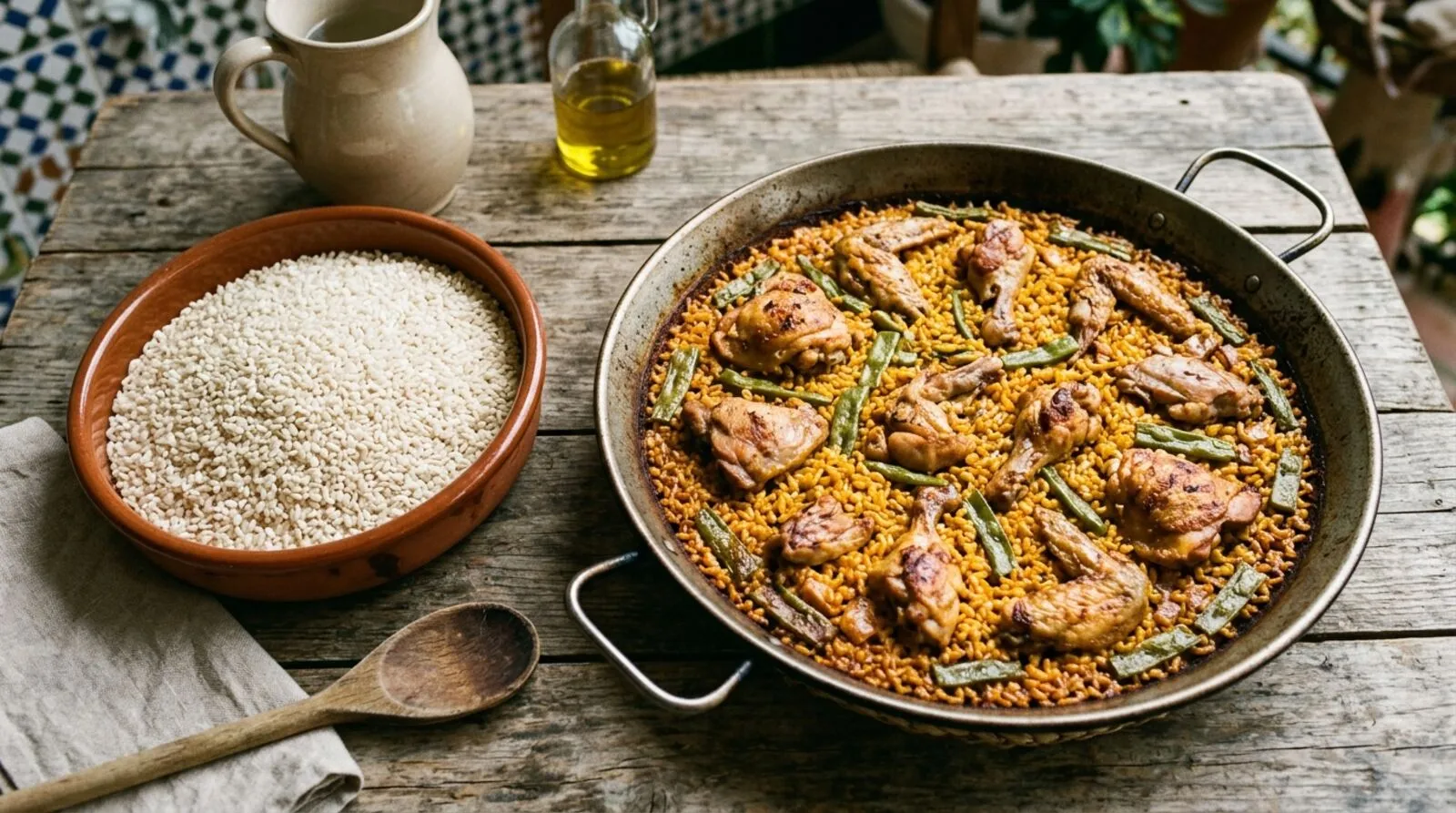
Rice arrived with al-Andalus between the 8th and 10th centuries (it is documented in the 10th) and survived centuries of bans. Paella, on the other hand, is young. The decree that declares it a Bien de Interés Cultural places its origin in L’Albufera, as food for farm and market-garden workers, and records a first mention of “arroz a la valenciana” in an 18th-century recipe manuscript, already with the warning that it must come out dry. In the 19th century it is eaten by every social class in the city, in 1885 the first divergences in the recipe appear and, at the end of the century, it jumps from the barracas to the beach eateries of La Malvarrosa, the Grao de Castellón and the Albufereta in Alicante. What goes in it and what doesn’t is in the Valencian paella entry, and the grain to use in the bomba rice entry.
The full story of paella and rice. What the documents say, what is legend and where the word comes from, in the origin of paella and the history of rice in Spain.
Stews, cocas and sweets: beyond rice
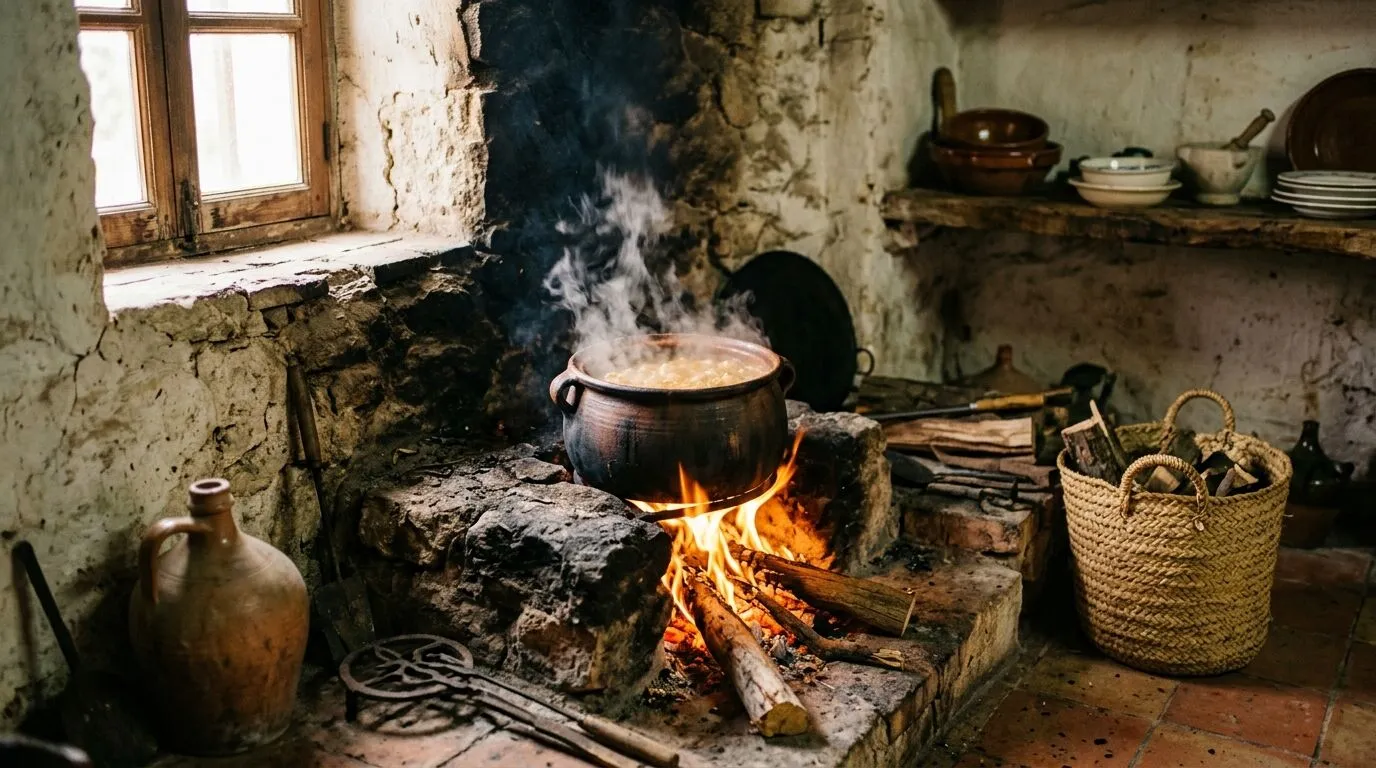
Valencian cuisine doesn’t end at the paella pan. In winter, inland and on feast days, the pot and the oven rule. For many of these dishes nobody has yet found an old document saying when they began, so we don’t put dates on them here. What we do know is where they are still made and on which days of the year.
Stews and spoon dishes
Alcoy’s olleta de músic takes its name from the nit dels músics, the night when the musicians who open the Moors and Christians are honoured. In the Vega Baja, the cocido con pelotas was food for special days and is still on many Christmas tables. And in Castalla and Pinoso, the Alicante gazpachos are a hot stew of meat and flatbread that has nothing to do with the cold Andalusian gazpacho: a humble mountain dish, made for the cold. The olla gitana of the Vega Baja is another stew of chickpeas and seasonal vegetables, which used to be made without meat. Alcoy also gives us the pericana, with roasted dried pepper and salt cod.
In the Guadalest valley, where wheat arrived before rice, blat picat, the wheat olleta, puts the age-old cereal where other stews put rice.
Cocas
The savoury coca is food for the oven and for fiestas. The most typically Alicante one is the coca amb tonyina of the Hogueras, which tradition says you eat on the night of the plantà, 20 June, with early figs. Another savoury Alicante coca is the coca de mollitas, topped with crunchy crumbs of flour, oil and salt.
Festive sweets
Here the sugar of Gandia and the almonds of the interior left their mark. The Easter mona is given by the godfather to his godchild on Easter Sunday, and many families go out to the countryside to eat it on those days. The sweet potato pastissets fill the Christmas trays. And turrón has had two protected geographical indications since 1996, Xixona and Alicante: in 2024, 4,516 tonnes of protected turrón were produced, according to the Generalitat. And the coca de llanda is the Valencian tray-baked sponge cake.
Alicante and the Vinalopó: the other Valencian cuisine
Let’s start at home. The bagged table grape of the Vinalopó has been a protected designation of origin since 1996, and its area covers Agost, Aspe, Hondón de los Frailes, Hondón de las Nieves, Monforte del Cid, Novelda and La Romana. According to its specification, bagging began in Novelda around 1920 to protect the bunches from the grape moth; each bunch ripens inside its bag. In 2024, 4,725 tonnes were protected.
Alicante wine also goes back a long way. The Consejo Regulador recalls that the traveller Jerónimo Münzer praised Alicante red wine in the late 15th century, highly esteemed in England, Scotland and Flanders. The designation of origin was created in 1932.
Rice isn’t only from L’Albufera either. The Vega Baja grew it in the late Middle Ages in the market gardens of Orihuela, even though it was banned. And the paella decree cites José Guardiola Ortiz, who in Gastronomía alicantina (1936) describes the rice with rabbit that was shared on St James’s Day on San Juan beach. At the end of the 19th century, the Albufereta in Alicante was one of the beach eateries where paella left the home.
| Dish or product | Area | What explains it | Find out more |
|---|---|---|---|
| Arroz con costra | Elche, Vega Baja | Baked rice with an egg crust, a celebration dish | Arroz con costra entry |
| Alicante gazpachos | Castalla, Pinoso | Hot mountain stew with flatbread | Stews and spoon dishes, above |
| Olleta de músic | Alcoy | The pot of the nit dels músics, before Moors and Christians | Stews and spoon dishes, above |
| Rellenos of Elda | Medio Vinalopó | Festive meatballs for the Virgen de la Salud (8 September) and Christmas | Elda rellenos step by step |
| Cocido con pelotas | Vega Baja | Food for feast days and Christmas | Stews and spoon dishes, above |
| Arroz y pata | Alicante | Casserole rice with boiled veal trotter and its own stock | Arroz y pata step by step |
| Arroz a banda and arroz del senyoret | Alicante coast | Fish stock; in the senyoret, everything comes peeled | Glossary entries, under “Sea” |
| Bagged grapes | Aspe, Novelda and the Vinalopó | DOP since 1996; bagging since around 1920 | Aspe fiestas and calendar |
| Turrón | Xixona and Alicante | Dry-land almonds and sugar; PGI since 1996 | Festive sweets, above |
Produce with a name of its own
A good part of this history ends up today on a label. The Comunitat Valenciana has 23 European quality schemes, according to the Generalitat’s 2024 agricultural report. These are some of the ones that weigh most in the kitchen:
| Product | Scheme | EU registration |
|---|---|---|
| Turrón de Jijona and Turrón de Alicante | PGI | 1996 |
| Bagged table grapes of the Vinalopó | PDO | 1996 |
| Cherries of the Montaña de Alicante | PGI | 1996 |
| Medlars of Callosa d’en Sarrià | PDO | 1996 |
| Chufa de Valencia (tiger nut) | PDO | 1999 |
| Arroz de Valencia (rice) | PDO | 2001 |
| Kaki Ribera del Xúquer (persimmon) | PDO | 2002 |
| Cítricos Valencianos (citrus) | PGI | 2003 |
| Alcachofa de Benicarló (artichoke) | PDO | 2003 |
| Granada Mollar de Elche (pomegranate) | PDO | 2016 |
Notice how many are from the south: cherries, medlars, grapes, pomegranate and two turrones. Six of the eleven products in this table are from Alicante.
What is still on the table at fiestas
A good part of this history is eaten every year at fiestas. At the Hogueras of Alicante people eat coca amb tonyina. At the Moors and Christians of Alcoy, the olleta. And World Paella Day has become one more excuse to fire up a paella in the street.
That custom of cooking for many and eating from the same paella is exactly what the BIC decree protects: “the art of bringing people together and sharing”. At Xepep, a family that has been feeding Aspe since 1960, that is what we still do when we take paella and live cooking to an event or feed a fiesta committee at local fiestas. If you are organising a big lunch, start with how much rice per person.
Where to go next
- To cook it: our traditional Valencian recipe collection, with its rice dishes and the Valencian paella recipe step by step.
- To understand the terms: the glossary of cooking and fiestas, with every rice dish and every word of Valencian cooking.
- To know when each thing is eaten: the calendar of fiestas and public holidays.
- To bring it to your event: catering in Aspe and the Vinalopó and, once you’re clear, get a quote.
If you want to go from history to the stove, the Vega Baja and Alicante have a place in the collection: camarrojas greens with sardines, salt cod meatballs, Vega Baja almojábanas and rice with pork and vegetables.
And for the oven and sweet doughs, try the All Saints fogassa, the coca Cristina or the arnadí, all with quantities, steps and sources.
Sources
- Alt de Benimaquia (Dénia), profile of Dr Carlos Gómez Bellard, MARQ Reuniones Científicas
- Roman fish-salting factory at the Portus Ilicitanus (Santa Pola), MARQ, Actuaciones arqueológicas 2003
- Expiración García Sánchez (CSIC), «Alimentación y paisajes agrícolas en al-Andalus», Ambienta 95 (2011)
- Review by L. Yungman of N. Nasrallah’s translation of Ibn Razīn al-Tujībī, BCAI 40 (IFAO)
- Conquesta de València, Gran Enciclopèdia Catalana
- History of the Water Tribunal, Càtedra L’Horta de València (Universitat de València)
- Organisation and workings of the Water Tribunal, Càtedra L’Horta de València (Universitat de València)
- Miriam Parra Villaescusa, «El cultivo del arroz en Orihuela a finales de la Edad Media», Medievalismo 23 (2013)
- Bueno Marí and Jiménez Peydró (2010), Crónicas de arroz, mosquitos y paludismo en España (Chronicles of rice, mosquitoes and malaria in Spain), Hispania (CSIC)
- Gastronomía medieval. El Llibre de Sent Soví i la cuina als segles XIV i XV, Universitat de València (2025)
- J. Santanach and A. Riera i Melis, La flor de totes les cuines: 500 anys del Llibre del Coc, Biblioteca de Catalunya
- Xavier Renedo, on Eiximenis and the Terç del Crestià, Anuario de Estudios Medievales 42/1 (2012)
- Manuel Ardit, «El sucre dels ducs de Gandia», Enciclopèdia Catalana
- M.ª Ángeles Pérez Samper, Historia de la comida en España. Los alimentos que vinieron de Occidente, Fundación Juan March
- Montserrat Durán, «La introducción de los cultivos americanos en Cataluña (ss. XVI-XVIII)», MAPA
- J. M. López Piñero and M. L. López Terrada, bibliography of Antonio José Cavanilles, Asclepio (CSIC)
- Review of Adrià Besó, Horts i tarongers (CEHI, Universitat de Barcelona)
- L’Horta de València, Globally Important Agricultural Heritage System (FAO Europe)
- Decree 176/2021 of the Consell, Valencian paella as an intangible Bien de Interés Cultural (BOE-A-2022-4133)
- Product specification for the PDO Uva de Mesa Embolsada Vinalopó (MAPA, 2015)
- Valencian agricultural sector report 2024, ch. IX: differentiated quality (Generalitat Valenciana)
- J. Coromines, Diccionari etimològic i complementari de la llengua catalana, entry «trapig» (IEC)
- Product specification for the PGI Turrón de Alicante (MAPA, 2023)
- Product specification for the PDO Chufa de Valencia (MAPA, 2021)
- Carcaixent, Gran Enciclopèdia Catalana
- Historical summary, Consejo Regulador de la DOP Alicante
- Regulation (EC) 1107/96: registration of turrones, Vinalopó grapes, cherries and medlars (OJ L 148)
- Regulation (EC) 378/1999: registration of the PDO Chufa de Valencia (OJ L 46)
- Implementing Regulation (EU) 2015/99, which cites the 2001 registration of the PDO Arroz de Valencia
- Regulation (EC) 245/2002: registration of the PDO Kaki Ribera del Xúquer
- Regulation (EC) 865/2003: registration of the PGI Cítricos Valencianos
- Regulation (EC) 1979/2003: registration of the PDO Alcachofa de Benicarló
- Implementing Regulation (EU) 2016/83: registration of the PDO Granada Mollar de Elche