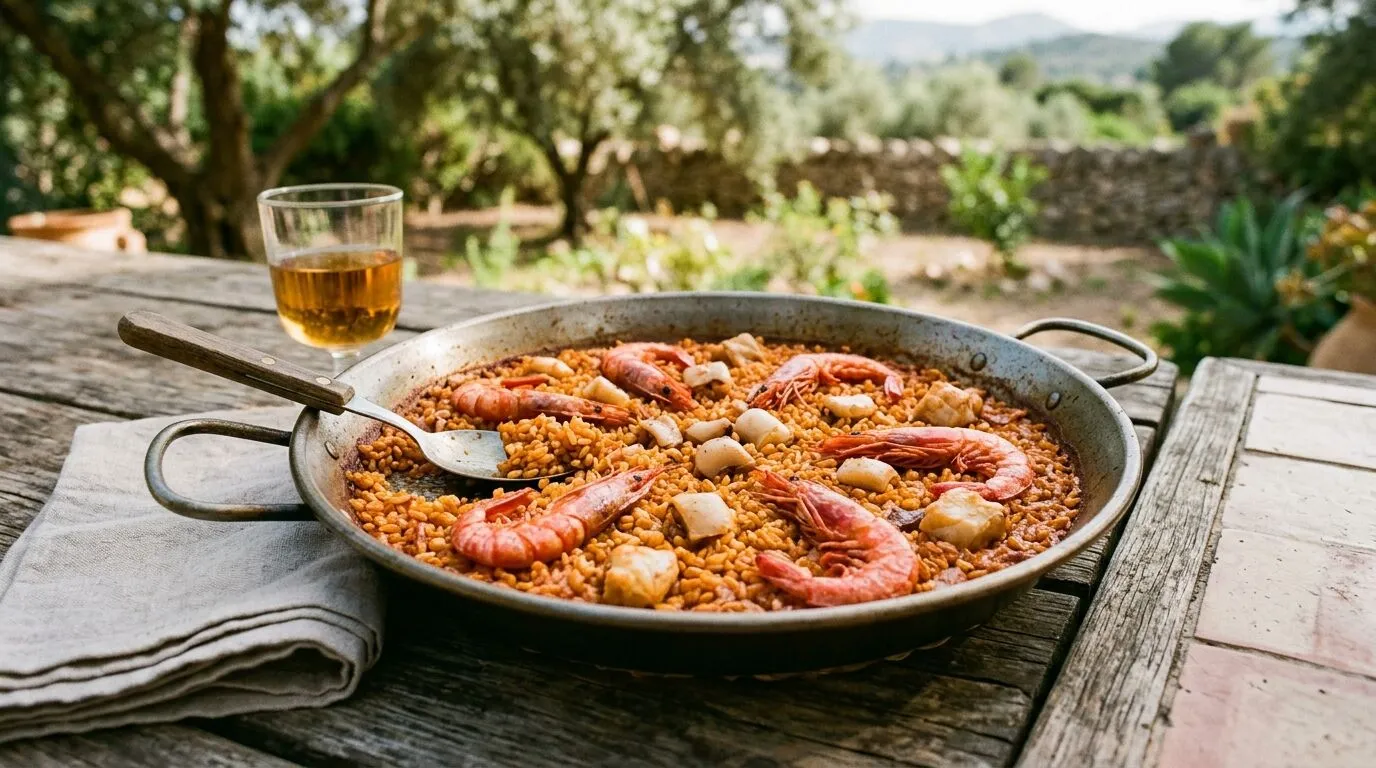

Arroz del senyoret (peeled seafood rice)
Yield: 4 servings
Suggested paella pans: 1 × 40 cm Glossary
Are there 40 or more of you? We cook rice dishes live for groups
Large paella pans need less liquid. Sources
Ingredients
Rice
- 400 gRice
- 800 mlFish fumet
- 150 gCuttlefish, very finely chopped
- 80 gKing prawns (gambones), peeled
- 200 gMonkfish, boned
- 100 gTomato
- 50 gExtra virgin olive oil
- to tasteLa Vera paprika
- to tasteSaffron
- to tasteSalt
- to tasteAllioli
Ingredients
- Fish fumet: Rockfish or small mixed fish (morralla) — 600 g
- Fish fumet: Water — 800 ml
- Fish fumet: Onion — 1 pcs
- Fish fumet: Leek — 1 pcs
- Fish fumet: Carrot — 1 pcs
- Fish fumet: Celery — 1 sprig
- Fish fumet: Garlic — 1 clove
- Fish fumet: Bay leaf — 1 leaf
- Fish fumet: Black peppercorns — 1 pcs
- Fish fumet: Extra virgin olive oil — 1 tbsp
- Fish fumet: Lemon juice — 0.5 tbsp
- Fish fumet: Fresh parsley — to taste
- Fish fumet: Salt — to taste
Steps
- 1Heat the 50 g in the paella pan, sear the diced 200 g over a high heat, with salt, and set it aside.
- 2In the same oil, fry the 150 g until it browns.
- 3Add the to taste, the to taste and the 100 g. Cook over a low heat, stirring and taking care it doesn’t burn, until the sofrito changes colour.5 min
- 4Add the 400 g and fry it briefly, so all the flavours come together.
- 5Pour in the hot 800 ml, return the monkfish to the pan and spread the grains over the whole surface. Cook over a high heat.14 min
- 6For the last 3 minutes keep the heat high so the rice forms the socarrat. Don’t stir it.
- 7In the last minute of drying, lay the peeled 80 g on top.
- 8Let the rice rest in the pan itself until the prawns finish cooking without drying out.3 min
- 9Serve straight away, with a little to taste on the side if you like.
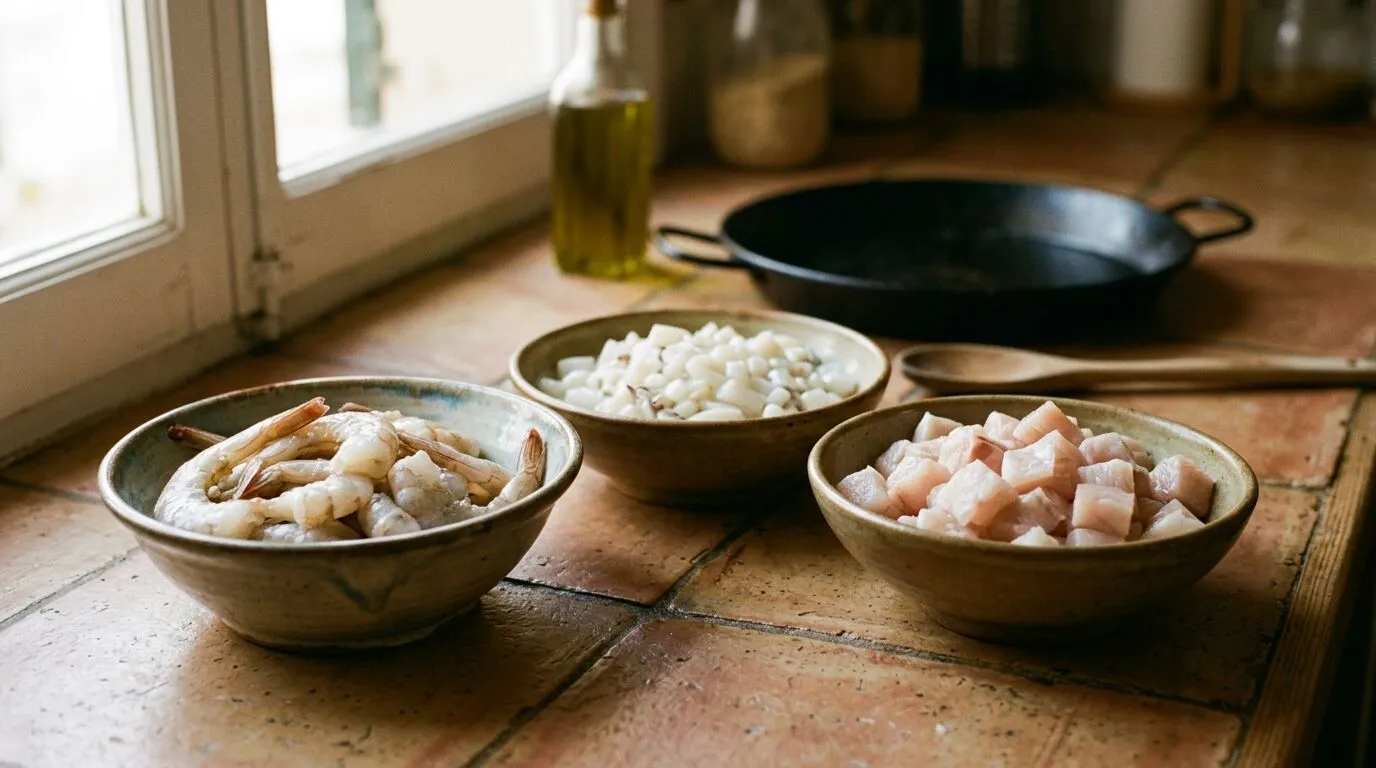
What sets arroz del senyoret apart is at the table: nobody peels anything. That takes work before you light the fire, and the recipe is organised around that work.
What gets peeled, what gets cleaned and when
On the day you make it, start with the shellfish. The king prawn (or prawn, or langostino, a large prawn) goes in peeled from the start; the cuttlefish very finely chopped; the monkfish boned and in small dice; and, if you add mussels, out of their shells. Monkfish isn’t in the Comunitat Valenciana PDF: we take it, with its quantity, from the Directo al Paladar recipe, because boneless fish is part of the dish according to the Turismo de Alicante guide. The shells and heads go into the stock: blend them with a little fumet, strain and return the result to the pot. That is how the rice tastes of the sea without anyone seeing a single shell.
With the fumet made (there is a fumet recipe) and the shellfish prepared, the rice goes quickly, which is why it suits group meals so well: the heavy work is done beforehand and all that is left in the pan is the cooking.
The sofrito and the finishing point
The Comunitat Valenciana recipe begins by browning the cuttlefish in extra virgin olive oil and then adds paprika, saffron and tomato, five minutes over a low heat, taking care the paprika doesn’t burn. The original PDF has two figures that don’t add up: 35 g of paprika and 15 g of saffron for four servings. These are obvious misprints, which is why they appear here “to taste”. A few threads of saffron and just enough paprika to colour the sofrito is plenty.
The rice goes in next, fried for a moment, and the fumet goes in hot. This is a dry rice, made in a wide paella pan, with the grain spread over the whole base. Cook over a high heat and, for the last few minutes of that same cooking, leave it alone so it forms the socarrat, the toasted crust. Then the king prawns on top and a short rest: the heat left in the pan cooks them just right.
How much stock
The proportion is another point of disagreement: the Comunitat Valenciana PDF asks for 2.5 litres for 400 g of rice, about six times its weight. Directo al Paladar uses twice as much stock as rice, 800 ml for 400 g, and the Turismo de Alicante guide gives the same measure for its Alicante rice. That is the one we use: it gives the loose, dry grain you expect from this rice.
What you can change without losing the dish
The morsels vary with the season and with what the fish market brings in. The rule doesn’t change: whatever goes in is ready to eat. Cuttlefish or squid, king prawns, prawns or langostinos, and perhaps a bivalve such as mussels, clams or escupiñas (warty venus clams), always out of the shell. The monkfish can be another firm white fish. The Comunitat Valenciana recipe recommends trying it with a little allioli, a rich sauce that lifts the fish and shellfish; you decide whether to put it on the table.
Typical mistakes
- Overcooked shellfish. A king prawn that goes in early comes out rubbery. The later it goes in, the better.
- Burnt paprika. It makes the whole base bitter. If you see it darkening, add the tomato straight away.
- Unseared monkfish. It falls apart in the rice; a brief searing in dice keeps it whole.
- Too much stock. The rice turns out soupy and the grain overcooks. Measure the fumet.
Similarities and differences with arroz a banda
They share fish stock and a dry finish. The difference is in how it is served: in the arroz a banda the fish is served apart, while here it is inside, already cleaned. Nor is it a fideuà, even though the fumet makes them close cousins.
A long table and everyone doing their own thing
This is the rice you will be glad of when people eat standing up, with children or with guests who don’t want to fight with shells. To work out quantities for a group, there is the guide to how much rice per person. And if there are 40 or more of you, we cook rice for groups live: tell us about your meal on our local fiestas page.
History and variations
The story goes that Jaime Baydal invented it in the 1960s, in his restaurant in Calp. Others claim it for Alicante, and some say it was born in Valencia, at La Pepica, when the painter Joaquín Sorolla asked for the langoustines to be peeled. The name plays on the young gentleman (*senyoret*) who doesn’t want to get his hands dirty, and the glossary entry tells it in more detail.
Tips
Peel the king prawns or prawns beforehand and blend the shells with a little fumet; strain and return the result to the stock, which gains flavour. Sources
The prawns go in for the last minute of drying and rest on top of the paella: that way they are just right and don’t dry out. Sources
Sear the monkfish in small dice and set it aside; it goes back into the pan together with the stock. Sources
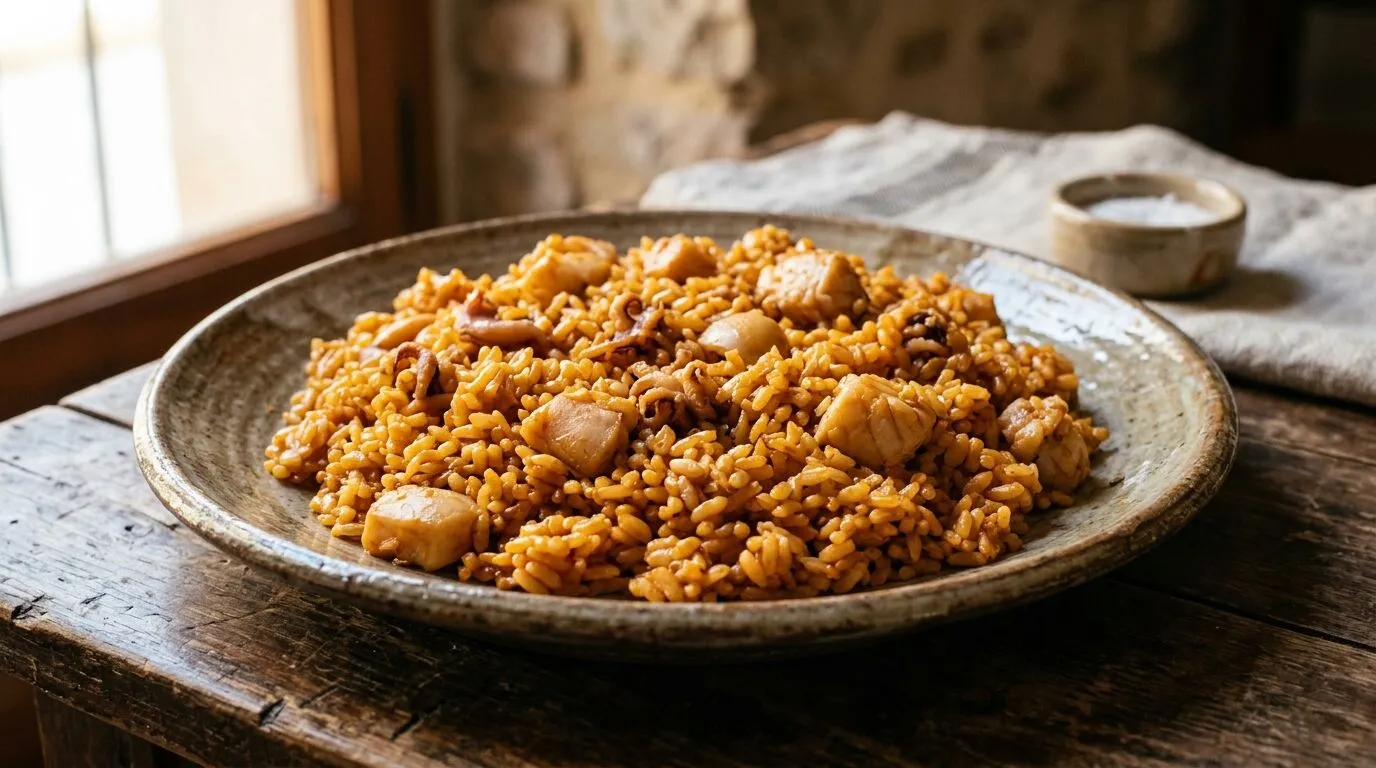
Arroz del senyoret (peeled seafood rice)
Frequently asked questions
Which shellfish do you peel and which do you leave in the shell for decoration?
Everything that goes into the rice is peeled: king prawns, prawns or *langostinos* (large prawns), and mussels out of their shells. That is the rule of the dish: morsels ready to eat. Don’t throw the shells away: blended with a little fumet and strained, they strengthen the stock. If you want a whole piece as a garnish, serve it apart so nobody has to peel it.
What stock can you use if there is no rockfish?
The Catalan-language Wikipedia (Viquipèdia) makes it with hake head, monkfish bones or *morralla* (small rockfish), and any of them gives a decent fumet. The Comunitat Valenciana recipe uses shellfish stock. What matters is that it is well strained and that you use the quantity on the recipe card, twice the rice, so the grain doesn’t overcook.
Why do the prawns go in at the end?
Because they cook in a moment and, if they go in with the rice, they end up tough and dry. The Comunitat Valenciana recipe lays them on in the last minute and lets them rest for three minutes on the paella, so they finish cooking in the residual heat and reach the plate juicy. The same goes for any peeled shellfish.
Sources
- Arroz del senyoret (Turisme Comunitat Valenciana, recipe in PDF)
- Arroz del senyoret (Turisme Comunitat Valenciana, recipe in PDF)
- Arroz al senyoret, the classic recipe (Directo al Paladar)
- Arròs del senyoret (Viquipèdia)
- Alicante, gastronomía y producto (Turismo de Alicante, 2022)
- Diccionari normatiu valencià (AVL): “arròs”, sub-entry “arròs de senyoret”
- Decree 176/2021 of the Consell, BIC status for Valencian paella (BOE)
Glossary terms
Recipes
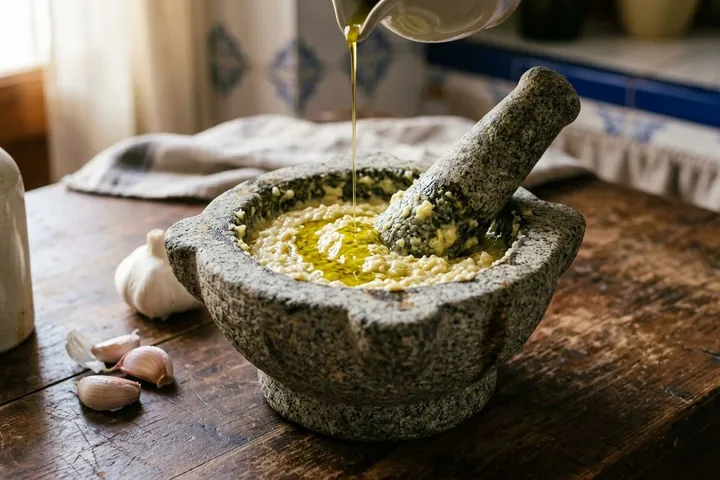
Mortar allioli
Traditional allioli is made in a mortar with just garlic, olive oil and salt. No egg, plenty of patience: the classic partner for arroz a banda and fideuà.
Total time: 20 min
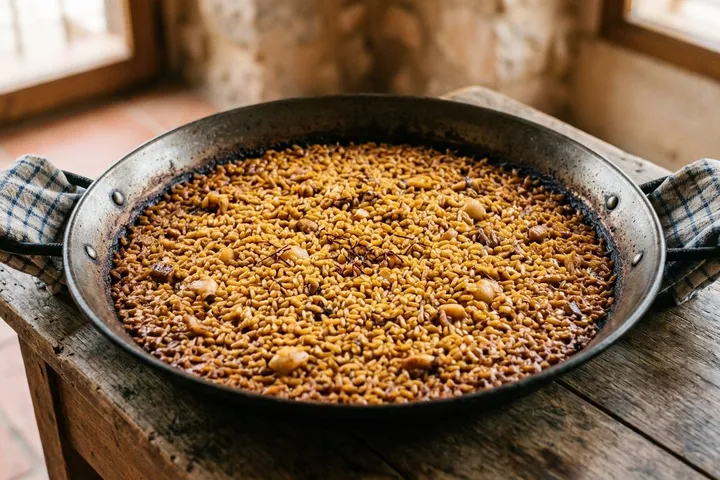
Arroz a banda
Arroz a banda for 4: ñora and baby cuttlefish sofrito, double the fish stock to rice, dry in the paella pan, fish served apart with potato and allioli.
Total time: 24 min
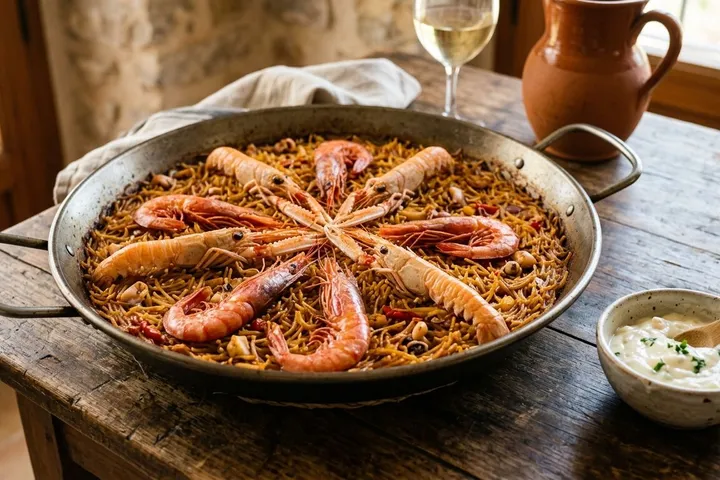
Fideuà de Gandia
Fideuà de Gandia for 6: 600 g of number 3 noodles, about 2 litres of rockfish stock, monkfish, cigalas and red prawns, cooked in a paella pan, with allioli.
Total time: 17 min
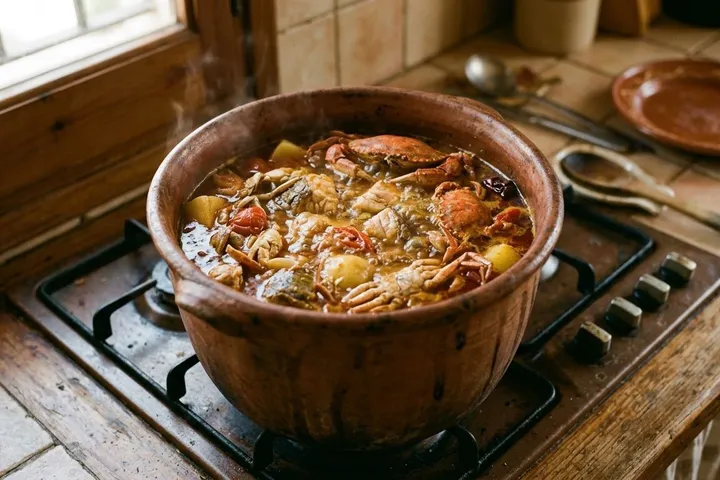
Fish fumet
Homemade fumet is cold water, fish bones and a few vegetables, cooked gently, skimmed and strained. It is the liquid base of seafood rice dishes.
Total time: 35 min
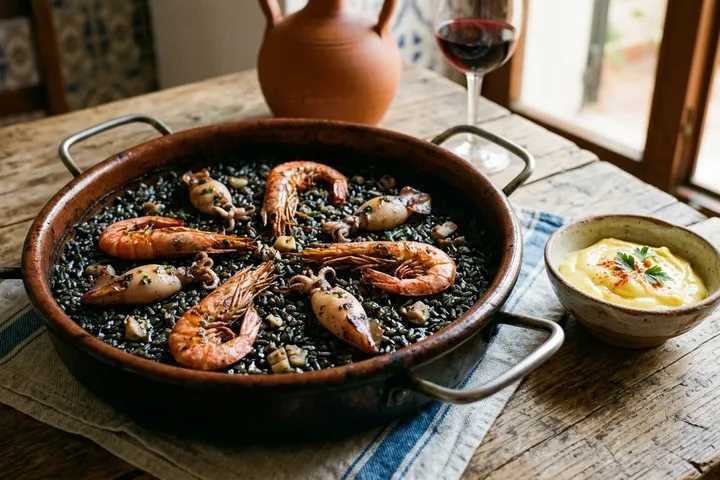
Black rice (arroz negro)
Black rice for 4: baby cuttlefish, ink, small-fish fumet and bomba rice, finished in the oven at 180 °C and served with allioli.
Total time: 30 min